
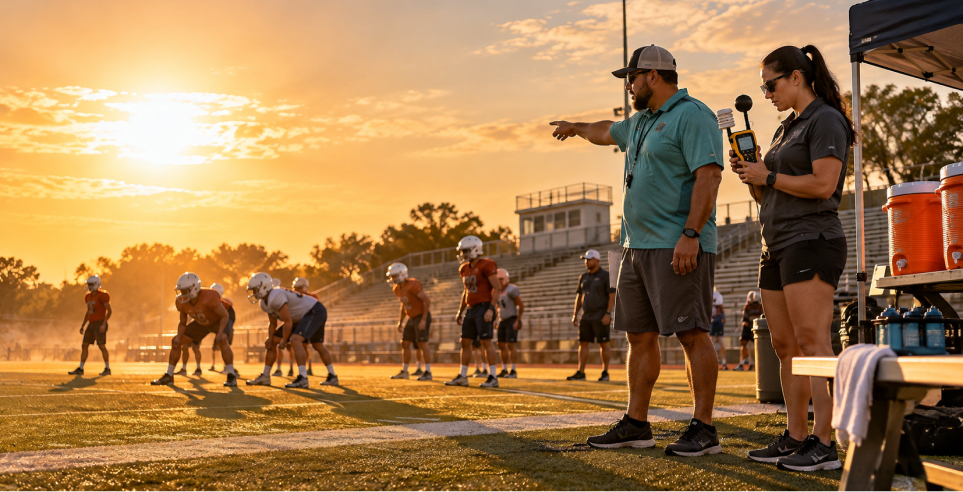

Texas high school football has entered a new era of heat safety regulation. Beginning August 1, 2026, the University Interscholastic League (UIL) made Wet Bulb Globe Temperature (WBGT) monitoring a required part of outdoor athletic practices and marching band activities, replacing a system that had previously treated the measurement as a recommendation.
Texas high school football’s evolving safety standards also highlight the differences between managing athletic competition and evaluating the broader sports industry. While UIL regulations focus on protecting student-athletes through heat monitoring and emergency preparedness, professional sports wagering operates within a separate framework of licensing, consumer protection, and platform oversight. Readers exploring JustBet vs Draftkings can consider how sportsbook operators differ in their regulatory environments, available features, and account policies. These distinctions reinforce the importance of understanding the rules governing each part of the sports landscape, whether they concern athlete safety on the field or consumer protections beyond it.
The change affects far more than how coaches check the weather. Football programs must now incorporate environmental readings into practice duration, protective equipment decisions, recovery periods, and emergency preparation. Across Texas, where preseason training begins in August, those decisions can reshape the daily routines of athletes, athletic trainers, and coaching staffs.
An October 2026 report from the San Antonio Express-News documented how local programs are adjusting to the requirements. Coaches including Larry Hill and Jeff Luna described the practical consequences of working around high WBGT readings, limited facility availability, and the need to preserve meaningful football preparation while protecting players.
The central question is no longer whether Texas schools should monitor heat stress. The UIL has settled that issue. Instead, the challenge is whether every program has the staffing, equipment, facilities, and organizational discipline to respond consistently when environmental conditions change.
Why Texas Made WBGT Monitoring Mandatory in 2026
The UIL’s decision followed several years of increasingly formal heat-safety guidance.
In 2023, the organization adopted WBGT as its recommended measurement for evaluating environmental conditions during outdoor school activities. Following a period of voluntary implementation, the UIL Medical Advisory Committee recommended moving to a mandatory standard.
The UIL Legislative Council approved the change, and the updated requirements took effect on August 1, 2026, for the 2026–27 school year.
According to the official UIL heat stress participation plan, schools must use WBGT information to guide activity modifications, including practice length, rest opportunities, hydration, and protective equipment.
The change reflects an important distinction between monitoring the weather and managing an athlete’s exposure to environmental stress.
A coach might previously have looked at an ordinary thermometer and decided whether afternoon practice felt reasonable. Under the updated policy, the decision must account for a more comprehensive measurement of the conditions athletes actually experience.
That distinction is especially important for football, where helmets, shoulder pads, physical exertion, and repeated high-intensity movements can complicate heat management.
The requirement also extends beyond football. Outdoor athletic programs and marching bands fall within the UIL’s heat protocols, making the regulation a broader operational issue for Texas schools.
What Is Wet Bulb Globe Temperature and Why Does It Matter?
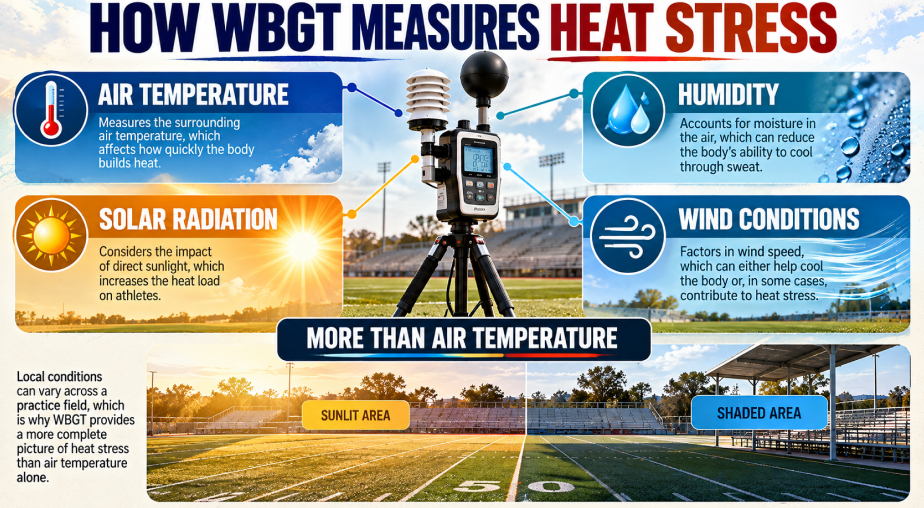
Wet Bulb Globe Temperature is a measurement used to assess environmental heat stress during physical activity.
Unlike ordinary air temperature, WBGT considers several environmental factors that influence the body’s ability to release heat.
These include air temperature, humidity, wind conditions, and solar radiation.
Humidity matters because it can limit the effectiveness of evaporative cooling through sweat. Direct sunlight can increase the heat load experienced by athletes, while wind influences how effectively heat moves away from the body.
This explains why two football fields with similar air temperatures can present different levels of environmental stress.
A practice in humid coastal Southeast Texas may require different precautions from one conducted in a drier part of West Texas, even when the thermometer displays the same temperature.
The UIL addresses these geographic differences through its Class 2 and Class 3 WBGT guidelines.
The distinction is operational rather than cosmetic. Schools must use the classification applicable to their location when interpreting the activity guidelines.
The UIL heat protocols FAQ also clarifies that readings apply to outdoor practices, covered pavilions, and indoor facilities that are not climate-controlled.
Moving athletes beneath a roof does not automatically eliminate the need to assess heat stress.
For athletic departments, the practical lesson is that WBGT should be treated as a decision-making tool, not simply another weather statistic.
How the New UIL Rules Change Football Practice Schedules
The most immediate impact of the 2026 policy is the requirement for regular environmental monitoring.
Schools must check WBGT conditions within 15 minutes before practice begins and every 30 minutes during outdoor activity.
When using an on-site instrument, the UIL instructs schools to set it up approximately 30 minutes before practice. Approved internet-based forecasting resources are also permitted under the policy.
As readings move into higher risk categories, schools must apply the appropriate restrictions to practice duration, work-to-rest ratios, and equipment.
The UIL also recommends maintaining records of readings, although its FAQ explains that retaining those records is not itself mandatory.
| Practice Requirement | 2026–27 UIL Standard |
|---|---|
| Initial WBGT check | Within 15 minutes before practice |
| Monitoring during practice | Every 30 minutes |
| Measurement methods | Scientifically approved instruments or accepted WBGT forecasting methods |
| Activity modifications | Based on applicable WBGT classification and guidelines |
| Rapid cooling capability | Required at specified WBGT thresholds |
| Water access | Unrestricted throughout activity |
These requirements change how coaches must organize their practice plans.
A session originally designed around a long sequence of position drills, team periods, and conditioning may need to be shortened or reorganized when environmental conditions worsen.
That does not necessarily mean every high reading requires an immediate end to practice. The UIL instructs responsible personnel to consider the current WBGT category, changing conditions, practice duration, athlete recovery, and the applicable activity guidelines.
However, it does mean that a fixed practice schedule cannot override required safety restrictions.
For programs accustomed to conducting much of their preseason work in the afternoon, early-morning practices become a potentially valuable scheduling option.
The trade-off is that cooler practice windows may conflict with transportation, staffing, facility access, and other school activities.
Those pressures become more complicated when several athletic programs share the same fields, weight rooms, indoor spaces, and athletic training personnel.
How San Antonio Coaches Are Adapting to the New Requirements
The San Antonio area provides an early example of how mandatory WBGT monitoring is changing high school football operations.
In reporting published October 15, 2026, the San Antonio Express-News examined how several programs have adjusted their schedules, staffing, and practice organization.
At Smithson Valley High School in Spring Branch, head coach Larry Hill described the new policy as an opportunity for coaches to reconsider established routines.
Hill, who had accumulated 346 coaching victories according to the report, observed that more programs are moving toward morning practices rather than relying on traditional afternoon schedules.
The adjustment is particularly significant because early-morning training can create different logistical demands from after-school practices.
At Poth High School, athletic director and head football coach Jeff Luna moved the boys’ high school athletic period to the beginning of the school day.
The decision also created a staffing challenge. Some Poth coaches had previously assisted with junior high practices, but moving activities into similar morning windows complicated those arrangements.
The report identified Poth as a Class 3A school with approximately 288 students enrolled during the previous school year.
That detail matters because smaller programs often rely on coaches who perform multiple responsibilities across grade levels.
At Brennan High School in San Antonio, head coach Stephen Basore raised a related concern: schools cannot necessarily move every team into the same morning practice window because field and facility capacity is limited.
Southwest head coach Alex Franco, meanwhile, reported observing fewer game-day cramping problems after his program shifted to morning practices. That is a local coaching observation rather than evidence that the scheduling change alone caused the improvement.
These examples illustrate a broader point. Compliance is not simply a matter of purchasing a thermometer. It requires coordination among coaches, administrators, athletic trainers, and the people responsible for allocating school facilities.
The San Antonio high school football heat safety report also documented concerns about lost outdoor practice time and the difficulty of preparing athletes for conditions they may encounter during games.
Why Practice Restrictions and Game-Day Rules Are Different
One of the most debated aspects of the new policy is the distinction between practices and competitions.
The UIL’s mandatory WBGT practice restrictions do not apply to games in exactly the same way.
Instead, schools are expected to monitor environmental conditions, maintain appropriate emergency resources, and consider modifications when contests take place in excessive heat.
The UIL recommends measures such as additional hydration opportunities, adjusted start times, shade structures, cooling equipment, and potentially longer halftime periods.
This distinction has raised questions among coaches who believe that some athletes may face significant heat exposure during games, particularly those who play both offense and defense.
The concern can be especially relevant at smaller schools, where roster limitations may require individual players to participate in a greater proportion of snaps.
A player competing throughout a game may experience substantial cumulative exertion even if the contest includes natural interruptions.
However, practices and games are organized differently. During practices, large groups of athletes may participate in sustained drills or conditioning periods, whereas game participation is typically interrupted by substitutions, timeouts, and changes of possession.
The UIL therefore applies specific activity limitations to practices while emphasizing emergency preparation and responsible modifications during contests.
There are still mandatory game-day requirements.
Under the official plan, competitions held at WBGT readings of 79.7°F or higher in Class 2 regions, or 82°F or higher in Class 3 regions, must have a rapid cooling zone available.
The UIL competition heat safety guidance also allows schools to consider rescheduling games in extreme conditions.
This means the absence of identical practice and game restrictions should not be interpreted as an absence of game-day safety obligations.
Rapid Cooling Zones Become a Critical Part of School Readiness
The most important element of heat emergency preparation is not the thermometer itself. It is whether a school can respond immediately when an athlete develops a serious heat-related emergency.
The UIL requires member schools to maintain emergency action plans that address heat illness and include rapid cooling procedures.
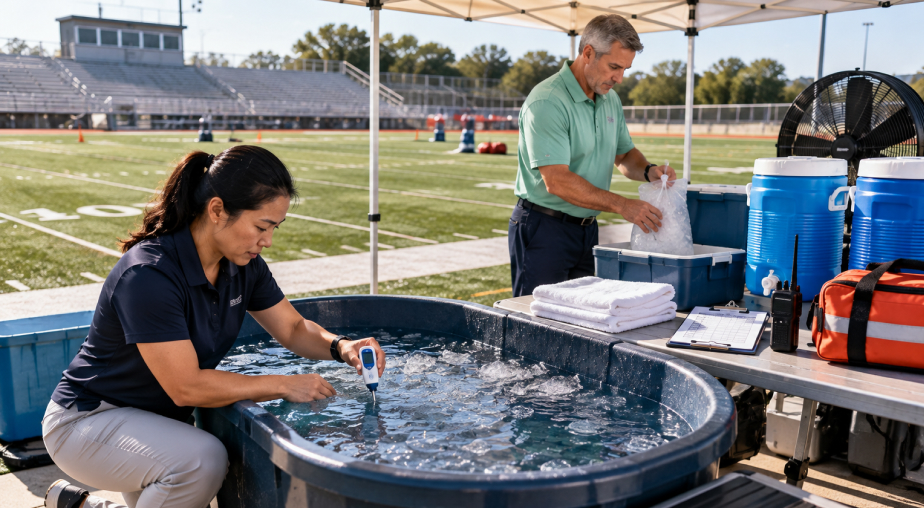
At the specified WBGT thresholds, rapid cooling zones must be available for outdoor athletic and marching band activities.
These zones must provide the capability for full-body cooling through cold-water immersion or an accepted equivalent method.
The UIL identifies immersion tubs and ice-water tarps, including tarp-assisted cooling methods, as options for meeting this requirement.
Shade, fans, misters, ice towels, and other cooling resources can support heat management, but they do not replace the required rapid cooling capability.
This creates several practical responsibilities for schools.
Athletic departments need to determine where emergency cooling equipment will be positioned, how it will be prepared, who can access it, and how medical personnel and emergency services will be contacted.
A cooling tub stored in a distant equipment room is not equivalent to a properly prepared response area immediately accessible during an emergency.
Likewise, an emergency action plan is only useful if the relevant personnel understand their responsibilities.
The UIL’s heat illness prevention resources emphasize the importance of preparation, education, and appropriate emergency response procedures.
For football programs, readiness therefore involves more than meeting the minimum environmental monitoring schedule. It also requires ensuring that emergency resources are functional and accessible whenever required.
Are Smaller Texas Schools Facing Greater Implementation Challenges?
The UIL’s standards apply across member schools, but the operational burden may vary significantly.
Large suburban programs may have multiple practice fields, dedicated athletic training personnel, and access to climate-controlled indoor facilities.
Smaller rural programs may have fewer available coaches, limited indoor space, and shared equipment or training resources.
Those differences do not change the safety requirements. They do, however, influence how schools can implement them.
Poth’s scheduling adjustments demonstrate the potential staffing challenge. When the same coaches work with high school and junior high athletes, moving multiple practices into cooler morning periods can create conflicts.
Facility limitations present another challenge.

An indoor gym can support film review, walkthroughs, individual instruction, and some technical activities. However, it may not reproduce the dimensions, spacing, or physical demands of a full football field.
Coaches must therefore decide which activities can be completed effectively indoors and which require an outdoor setting when conditions permit.
Financial resources also matter. Schools may need access to reliable WBGT measurement tools, cooling equipment, sufficient ice and water, and appropriate storage or transportation arrangements.
The UIL permits scientifically accepted forecasting methods, which can reduce the need for every school to purchase the same type of instrument. Nevertheless, the responsibility to obtain readings and follow the guidelines remains.
The larger issue is not whether smaller schools should receive weaker protections. It is how districts can support consistent implementation despite differences in resources.
What the 2026 Football Season Reveals About Heat Acclimatization
Heat acclimatization remains an important consideration in preseason football preparation.
Athletes need appropriate opportunities to adapt to physical activity in warm environments, but those opportunities must remain within established safety limits.
The new UIL policy requires coaches to balance that process against environmental conditions that can change throughout a practice.
This balance becomes particularly relevant during August and September, when Texas teams are preparing for regular-season competition.
The official 2026 UIL football calendar scheduled the first conditioning sessions for August 3 for many classifications, with the opening week of games beginning August 27–29.
Those dates place early football preparation squarely within a period when substantial heat exposure is possible.
A shortened practice may require coaches to prioritize fundamental technique, positional responsibilities, and efficient team periods rather than attempting to preserve every element of a traditional session.
Programs can also use video analysis, classroom instruction, and carefully organized walkthroughs to supplement physical preparation.
However, those alternatives should support rather than replace appropriate football-specific conditioning and progressive acclimatization.
The UIL’s policy provides environmental limits, while qualified athletic trainers and other appropriate medical professionals remain essential to managing individual athlete health concerns.
The objective is not to eliminate outdoor training. It is to prevent unsafe exposure while preserving effective athletic development.
How Texas Could Refine the WBGT Policy Before the 2027 Season
The 2026 season represents the first year of mandatory statewide implementation, making feedback from schools especially important.
According to October reporting, the UIL Medical Advisory Committee discussed the policy during a September 13 meeting and was collecting information from coaches and athletic programs.
The committee was expected to revisit the issue in April 2027.
That review creates an opportunity to assess whether the existing requirements are producing the intended safety improvements while identifying operational difficulties that may require clarification.
Potential areas for examination include the relationship between practice and contest restrictions, the use of indoor facilities, staffing limitations, and the consistency of WBGT measurement procedures.
Other states provide useful comparisons, although their approaches cannot automatically be transferred to Texas.
Georgia, for example, has an established history of heat-safety regulation in high school athletics.
In the San Antonio report, University of Georgia clinical professor emeritus Bud Cooper discussed the experience of implementing heat policies and the importance of protecting athletes without undermining competitive football.
The comparison suggests that successful implementation depends partly on whether safety procedures become routine elements of coaching and athletic administration.
Texas’s challenge is to develop that consistency across a much larger and geographically diverse high school sports system.
Any future policy changes will need to preserve the central objective: reducing preventable heat-related illness while allowing students to participate in organized athletics.
What Texas Athletic Departments Should Prioritize Moving Forward
As the 2026 football season progresses toward its November playoffs, the new WBGT requirements should become part of everyday athletic department operations rather than an exceptional preseason procedure.
The UIL’s published football calendar places district certification on November 7, with the first playoff round scheduled for November 12–14.
Although cooler weather may reduce heat exposure in some locations later in the season, environmental conditions still require appropriate evaluation whenever the policy applies.
Schools can strengthen implementation by assigning clear monitoring responsibilities, coordinating facility schedules, maintaining cooling equipment, and reviewing emergency procedures with the people responsible for athlete supervision.
Administrators should also consider how the rules affect younger athletes and sub-varsity teams, whose practice schedules may differ from those of varsity programs.
Parents and athletes benefit from understanding why a practice may be shortened, moved indoors, or rescheduled.
Transparent communication can help establish that these decisions are based on environmental measurements and established safety procedures rather than arbitrary coaching preferences.
Ultimately, Texas high school football programs will be judged not only by their ability to follow the written WBGT requirements but also by how effectively they integrate those requirements into daily practice.
The strongest programs will treat environmental monitoring, athlete recovery, emergency readiness, and football development as connected responsibilities.
For Texas schools, the 2026 season is an important test of whether statewide heat-safety standards can become consistent, practical habits across every level of high school athletics.