
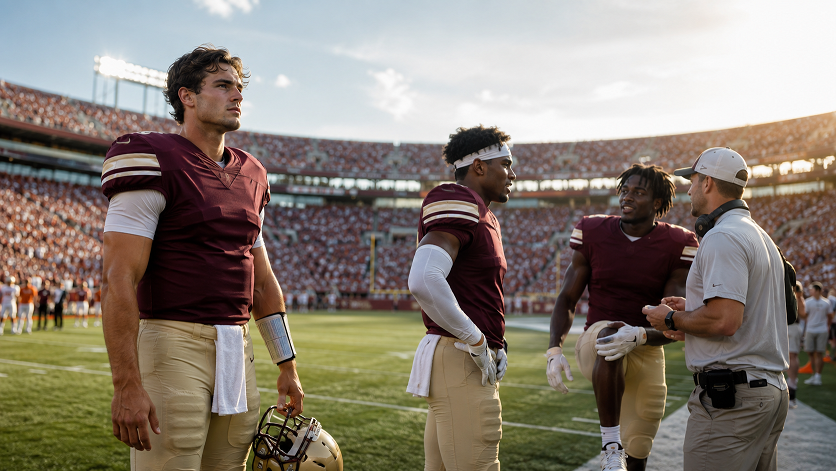

Texas State officially moved into the Pac-12 this summer, but the Bobcats’ new conference identity will receive its first meaningful football test before league play even begins. On September 5, G.J. Kinne’s team travels to Austin to face Texas at Darrell K Royal-Texas Memorial Stadium, with kickoff scheduled for 2:30 p.m. Central on ESPN.
The matchup arrives at a useful moment for Texas State. The Bobcats are coming off a 7-6 season that ended with a 41-10 victory over Rice in the Armed Forces Bowl, their third consecutive bowl win and third straight season with at least seven victories. Texas State is no longer trying to prove that Kinne can make the program competitive. The next question is whether that progress can translate onto a stage that resembles the pressure the Bobcats hope to encounter regularly in their new conference.
Brad Jackson Gives Texas State A Proven Starting Point
Texas State enters Austin with one of the most productive returning quarterbacks in the state.
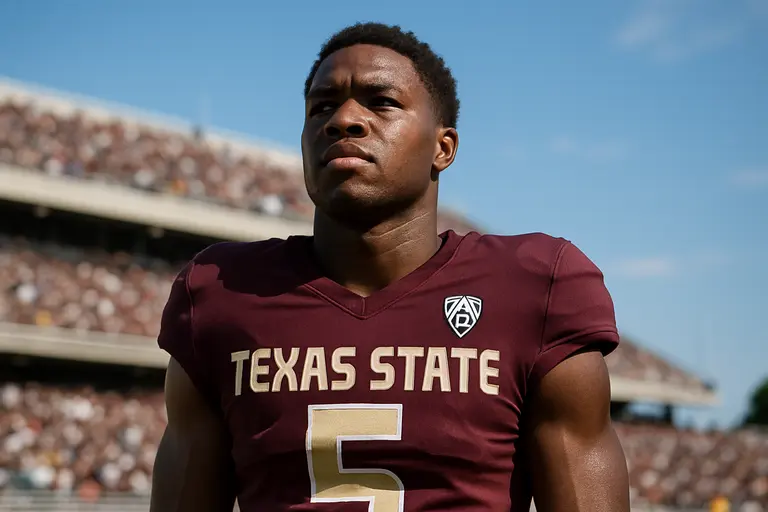
Brad Jackson started all 13 games in 2025 and completed 251 of 352 passes for 3,224 yards and 21 touchdowns. His 71.3 percent completion rate set a Texas State single-season record and ranked fifth nationally. He added enough production on the ground to finish with 3,968 yards of total offense and 38 touchdowns responsible for, both program records.
Those numbers matter against Texas because the Bobcats cannot expect to control the game through field position alone. Jackson gives Kinne a quarterback capable of operating the tempo-heavy offense that has become Texas State’s clearest identity.
His mobility creates another problem for a defense preparing for spread formations. Jackson rushed for a school-record 17 touchdowns last season, giving Texas State a red-zone element that goes beyond designed running-back carries.
The challenge in Austin will be whether that production holds when the windows become smaller and the defensive front becomes faster. Texas State dominated portions of its 2025 schedule through offensive volume. Against Texas, efficiency will matter more. A stalled drive or early turnover could quickly change the atmosphere inside a stadium where the Bobcats will be playing as clear underdogs.
Two 1,000-Yard Receivers Make The Matchup More Interesting
Jackson is not entering the opener without established targets.
Beau Sparks produced 84 receptions for 1,200 yards and 10 touchdowns in 2025. Chris Dawn Jr. added 65 receptions for 1,007 yards and four scores. Both were named to the 2026 Biletnikoff Award preseason watch list in August.
That gives Texas State something most teams entering a major road opener would welcome: continuity at quarterback and multiple receivers who have already handled large workloads.
Sparks gives the offense proven downfield and intermediate production. Dawn averaged 83.9 receiving yards per game last season and posted five 100-yard performances. His 11 receptions in the Armed Forces Bowl set a record for that event.
Texas will test whether those numbers reflect an offense capable of producing against higher-end defensive backs or one that benefited heavily from its previous schedule.
The answer matters beyond September 5.
Texas State begins Pac-12 play October 3 at San Diego State and later travels to Boise State and Oregon State. If Jackson, Sparks and Dawn can generate consistent offense in Austin, the Bobcats will have evidence that their passing game can travel into the more difficult environments awaiting them later in the season.
The Schedule Makes Austin More Than A Standalone Showcase
The Texas game starts a four-week stretch built entirely around in-state opponents.
After Austin, the Bobcats return to UFCU Stadium to host UTSA on September 12, North Texas on September 19 and Incarnate Word on September 26. Pac-12 play then begins with a 9:30 p.m. Central kickoff at San Diego State on October 3. The official Texas State schedule places the Bobcats on national linear television for each of those opening games.
That sequence gives Kinne an unusual opportunity.
Texas State can measure itself against one of the state’s biggest programs, then spend three consecutive weeks in San Marcos correcting what the Texas game exposes. UTSA provides rivalry pressure. North Texas gives the Bobcats a rematch of a recent postseason opponent. UIW becomes the final preparation point before the geography and travel demands of Pac-12 football begin.
The broader attention around an all-Texas opening month will extend well beyond the stadium. Some fans follow everything from television coverage and rivalry history to regional sports-market resources such as trusted offshore sportsbooks for Texas residents. That secondary interest reflects how widely Texas football is followed, but the Bobcats’ central challenge remains competitive: prove that their recent success can survive a major increase in schedule visibility.
G.J. Kinne’s Offense Will Be Tested By Pace And Possession
Kinne has built Texas State around an aggressive offensive identity.
The Bobcats finished 2025 ranked eighth nationally in total offense at 475.8 yards per game, 12th in rushing offense at 220.5 yards and 17th in scoring at 36.1 points per game. Those figures came during a season in which Jackson emerged as both a high-percentage passer and a major rushing threat.
Austin presents a different question.
Tempo can create advantages when an offense stays ahead of schedule. It can create problems when incomplete passes, penalties or negative runs produce quick three-and-outs. Giving Texas repeated possessions without forcing its defense to remain on the field for long stretches would place additional stress on the Bobcats.
Texas State does not need to abandon its identity. It needs to show that the offense can control its speed rather than simply play fast.
A productive opening drive would matter. Converting third downs would matter more. Avoiding turnovers may matter most.
The Bobcats’ best route to making the fourth quarter relevant is likely to involve sustained possessions rather than attempting to win a pure scoring race from the opening kickoff.
The Texas Game Can Reveal More Than The Final Score
Texas State does not need an upset in Austin for the opener to provide useful evidence.
The Bobcats need to determine whether their offensive line can protect Jackson against greater speed, whether their receivers can separate from stronger coverage and whether the defense can prevent explosive plays. Those answers will be more valuable for the Pac-12 schedule than a simple comparison between the final scores of Texas State and Texas.
This is one reason the timing works for the Bobcats.
A difficult opponent arrives first rather than after several weeks of assumptions built against weaker competition. Kinne and his staff will receive an immediate assessment, then have three home games to adjust before conference play.
For a program entering a new league, that is useful information.
Texas State’s seven-win 2025 season established a floor. Three consecutive bowl victories established consistency. Jackson’s return gives the offense a centerpiece. Sparks and Dawn give him proven targets.
Austin will test how much those achievements carry into the next level of the program’s development.
Why September 5 Matters To The Pac-12 Transition
Conference realignment becomes real when the football changes.
Texas State can introduce Pac-12 branding, new television agreements and future conference opponents, but none of those elements determines whether the Bobcats can compete with the strongest teams on their schedule.
The Texas opener offers the first serious clue.
A competitive afternoon in Austin would reinforce the argument that Texas State enters the Pac-12 with more than momentum from its former conference. It would show that Kinne’s offense can create problems against elite speed and that the returning core is prepared for a larger stage.
A difficult loss would expose areas that need attention before October.
Either result can be useful if Texas State responds correctly.
The Bobcats will leave Austin and immediately prepare for UTSA, North Texas and UIW. By the time they board a flight for San Diego State, coaches will have four games of evidence about a roster entering unfamiliar conference territory.
That is why September 5 is bigger than a one-day opportunity against Texas.
It is the first real measurement of whether the progress Texas State built over the last three seasons is strong enough to follow the program into the Pac-12.