
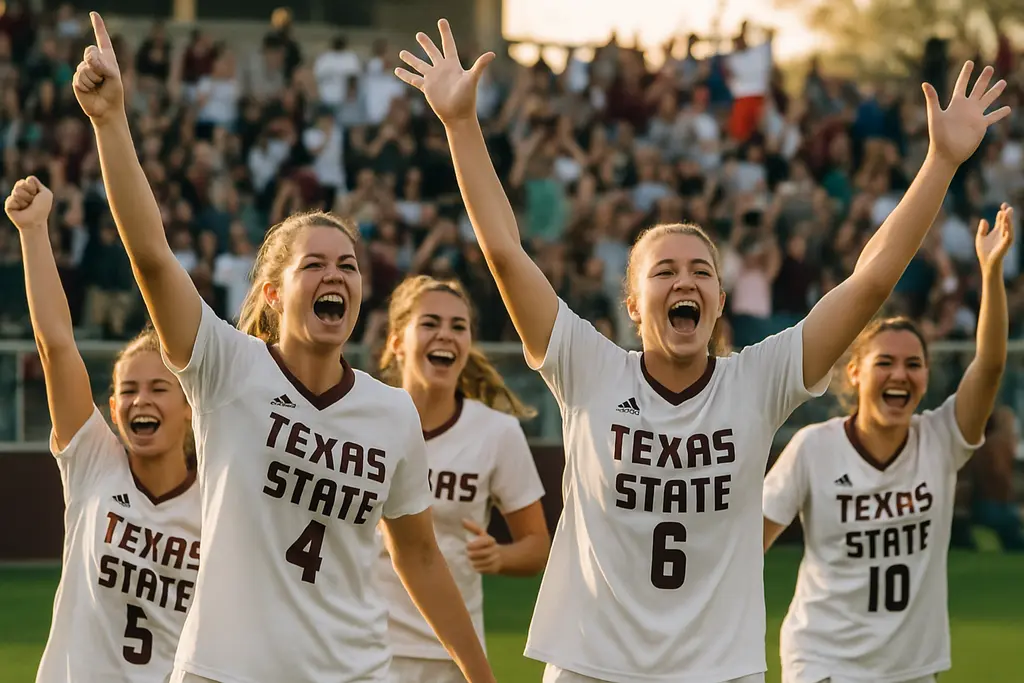

Texas State Soccer did more than beat a name-brand opponent on August 19, 2026. The Bobcats defeated Texas A&M 3-2 at the Bobcat Soccer Complex in San Marcos, claiming the program’s first-ever win over an SEC opponent, according to the Texas State match recap. For a program building toward Pac-12 competition, that result gave Steve Holeman’s group a local proof point: Texas State could absorb pressure, answer late and finish off a Power-4 opponent on its home field.
Why The Texas State Soccer Win Carried Weight
Texas State Soccer And The SEC Breakthrough
The scoreboard mattered, but the label beside the opponent mattered too. Texas A&M arrived as an SEC program, and Texas State had never beaten an SEC opponent before that night. That does not make one August result a finished statement about the season. It does make the win a marker for where the Bobcats want the program to sit in the wider college soccer conversation.
For San Marcos, the setting also gave the night extra value. The result happened at the Bobcat Soccer Complex, not on a neutral field or as a distant road surprise. Local wins against major-conference opponents can change the feel around a program because players, students, families and returning supporters experience the moment in the same place where the team trains, grows and builds its identity.
Texas State Soccer has often needed these kinds of nights to be judged beyond conference labels. The A&M result gave the Bobcats a clean answer to a question every rising program faces: can they beat a physically capable, well-known opponent when the match turns late? On August 19, Texas State’s answer was yes.
Power-4 Context, Not Empty Hype
The win also stood as only the third victory in program history against a Power-4 opponent, with the earlier results coming against Houston in 2023 and Texas Tech in 2002, according to Texas State’s recap. That context matters because it keeps the discussion grounded. This was not treated as routine by the program’s own record book. It belonged in a small group of results that show how difficult these matchups have been across the years.
There is also a timing element. Texas State had moved into a larger competitive frame with Pac-12 play on the schedule, and early non-conference matches against bigger-name opponents offered a chance to test the group before league pressure arrived. A win like this does not settle the Pac-12 race before it starts. It does give coaches a stronger teaching film and players a reference point when the next high-speed match asks for late composure.
The Late Response That Changed The Match
Meza’s Finishing And Ngankem’s Timing
The match turned because Texas State produced late answers after falling behind 2-1. Jenny Ngankem tied it in the 79th minute, then Victoria Meza scored the winning goal in the 87th minute after a ricochet from the Texas A&M goalkeeper. That sequence is the kind coaches can use for weeks: a team trailing late, still pushing numbers into dangerous areas and still sharp enough to punish a loose ball.
Meza’s winner carried personal weight as well. It was her 15th career goal for Texas State and part of her second consecutive brace, meaning she scored twice in back-to-back matches including the Texas A&M win. That kind of finishing gives a team more than goals. It changes how opponents must defend and gives midfielders confidence that a service into a crowded box can still become something decisive.
Ngankem’s equalizer should not get lost beneath the winning goal. A late tying goal changes the emotional rhythm of a match. It forces the opponent to respond under pressure and gives the home side a new surge. For Texas State Soccer, the two-goal late push showed more than attacking talent. It showed a group that did not let the 2-1 deficit define the last stretch of the night.
What Coaches Can Take From The Final Ten Minutes
Late-game execution is one of the clearest ways to separate a promising team from a mature one. The Bobcats needed timing, movement and persistence to flip the match. They also needed enough belief to keep playing forward when the safer emotional response would have been frustration.
That matters because Pac-12 matches can be decided by brief windows. A loose clearance, a second ball, a keeper’s deflection or one well-timed run can swing a result. The Texas A&M match gave Holeman and his staff a live example of players staying connected under match pressure. Coaches value that kind of evidence because it is harder to create in training than in a real match with the clock working against you.
What The Result Says About Program Standards
From A&M To Baylor, A Bigger Résumé
The Texas A&M win gained even more meaning four days later. On August 23, 2026, Texas State beat No. 6 Baylor 3-1, the program’s first win over a ranked opponent, as reported by Yahoo Sports. Taken together, those results gave the Bobcats two early non-conference results with real résumé value: one against an SEC opponent and one against a top-10 ranked opponent.
For NCAA Tournament consideration, early wins do not guarantee anything by themselves. They do, though, give a team stronger reference points if the season remains competitive. Selection profiles are shaped by quality wins, schedule strength and how a team performs across the full campaign. Beating Texas A&M and Baylor in the same opening stretch gave Texas State Soccer a firmer foundation than a set of close losses would have provided.
The Baylor result also protected the A&M win from being viewed as a one-night spike. Backing it up against a ranked opponent suggested that the Bobcats were not simply catching one opponent cold. They were carrying form, finishing chances and finding ways to close matches against programs with broader name recognition.
How The Pac-12 Schedule Frames The Next Test
The schedule context now sharpens the meaning of August. Texas State was set to begin Pac-12 play at Utah State on October 1, 2026, according to Yahoo Sports. That date gives the coaching staff a clear dividing line: non-conference results built the résumé, while conference play would begin testing week-to-week consistency.
For readers tracking how the Bobcats fit into their new league schedule, the broader conference path was already part of the local discussion around Pac-12 matchups to watch. The Texas A&M result added a different layer to that conversation. It gave the Bobcats a win they could carry into tougher travel, unfamiliar opponents and the pressure of establishing themselves in a new conference setting.
The key is not to overstate one week. Soccer seasons can turn on injuries, form, travel rhythm and finishing margins. Still, the A&M and Baylor results showed Texas State could turn opportunity into wins rather than moral victories. That is an important line for a program trying to raise standards without losing its local edge.
Why The Texas A&M Win Matters In San Marcos
A Local Result With Program Reach
For San Marcos supporters, the Texas A&M win felt important because it happened in front of the home community and because it gave the Bobcats a result that travels well beyond Hays County. Recruits, alumni and conference opponents can all understand what a 3-2 win over an SEC opponent represents, even without seeing every minute of the match.
That kind of result can also help define internal expectations. Players who were on the field now have a shared example of what the team looks like when it responds under pressure. Younger players in the program can see that late-game belief is not just a coaching phrase. It produced a real win against a major-conference opponent.
Texas State Soccer still had to prove itself across the rest of the schedule after August 19. One result did not finish the work. But it changed the tone of the conversation around the Bobcats. Instead of asking whether Texas State could break through against an SEC team, the program could point to a night in San Marcos when it already did.
The best part for the local soccer community is that the win was not built on a single lucky moment. It included a comeback, a late equalizer, an experienced finisher delivering the winner and a follow-up upset of Baylor four days later. That combination gave the Bobcats something sturdier than a headline. It gave them evidence that their ceiling had moved.
As Pac-12 play approached on October 1, the Texas A&M win remained one of the clearest signs that Texas State had entered a different competitive conversation. The program still needed consistency, health and results across the full schedule, but San Marcos had already seen what this group could do when the match demanded a late answer.