
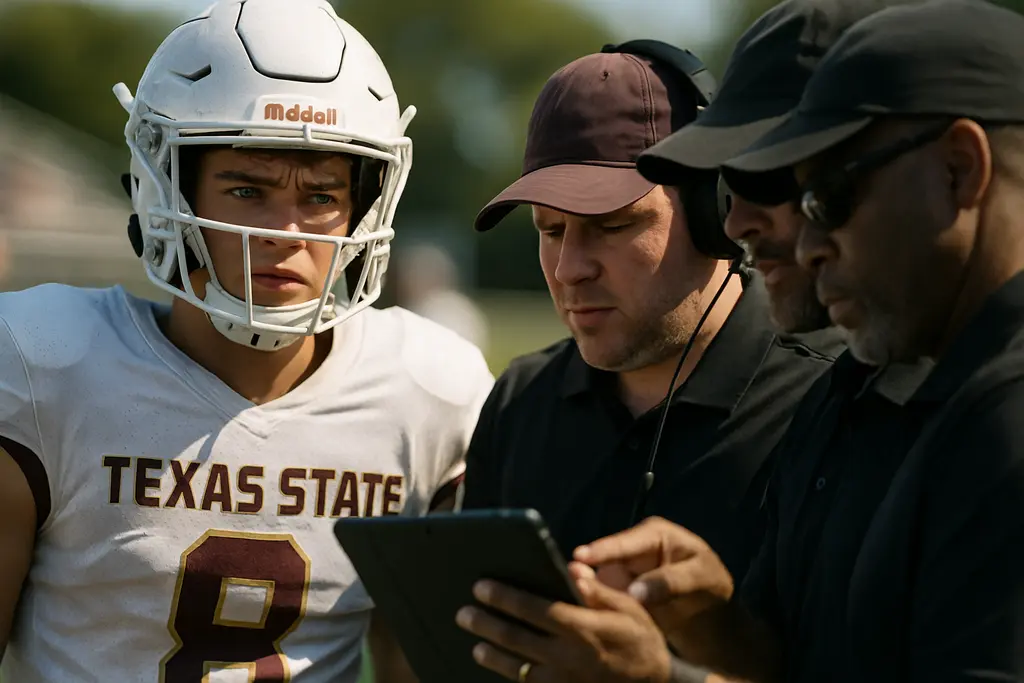

Texas State Recruiting has taken on a sharper local meaning since the Bobcats entered the Pac-12 on July 1, 2026. The move gave the program a bigger conference label, but the early recruiting story has stayed rooted in Texas high school football. Rather than treating Pac-12 status as a reason to chase only distant prospects, Texas State has used it as a stronger pitch to players who already understand San Marcos, the I-35 corridor and the weight of staying close to home while playing on a wider stage.
Texas State Recruiting Turns Pac-12 Status Local
The most telling part of the Bobcats’ first Pac-12 recruiting push is not simply the number of commitments. It is where those players are coming from.
Texas State Recruiting Built Around Familiar High Schools
On July 7, 2026, Texas State added 16 commitments to its 2027 class. According to a Yahoo Sports report, that group included one 4-star prospect, running back Daylon Gordon, and 11 3-star high school recruits. The same report noted that the 2027 class included 15 high school commitments, with 14 from Texas.
That matters for a program trying to keep local relationships active while changing conferences. Texas high school coaches want to see whether a new league move changes a staff’s recruiting habits. In Texas State’s case, the first signs point toward continuity with a stronger sell. The Bobcats can now talk about Pac-12 membership without giving up their local scouting base.
The 2026 recruiting cycle showed the same pattern before the Bobcats officially entered the league. Yahoo Sports reported that the 2026 class ranked 74th nationally and included 14 of 15 signees from Texas high schools. That gives the 2027 activity context: the in-state push did not begin after July 1, 2026, but the Pac-12 move has given the pitch more reach and more weight in living rooms across the state.
The Daylon Gordon Signal
Gordon’s commitment stands out because it gave Texas State its highest-rated all-time commit, according to the Yahoo Sports report. The running back committed in early June 2026 and was ranked 22nd nationally at his position in the research provided.
One player does not define a class, but a commitment like Gordon’s can change the tone of conversations with other local recruits. For years, Texas State has had to sell opportunity, playing time and campus fit. Those points still matter. The Pac-12 piece now gives the Bobcats a cleaner answer when a Texas recruit asks whether staying in San Marcos can still bring national attention.
What The 2027 Class Shows About The Map
The strongest sign for Texas State Recruiting is that the program is not relying on a single headline pledge. The class structure points to a broader push across Texas, with high school prospects making up the center of the plan.
Ranking Data Gives The Class A Pac-12 Frame
As of the late-June 2026 commitment snapshot included in the research, Texas State’s 2027 class ranked fourth in the Pac-12 and 75th nationally, with 68% of commits coming from in-state. The class listing is tracked by On3’s Texas State commitments page. Rankings will shift as other programs add players and as prospects are re-evaluated, but that placement gave the Bobcats a strong early position inside their new conference.
The in-state percentage is just as meaningful as the league ranking. Texas State is now competing in a conference with schools spread across a wider western footprint, but the Bobcats’ first recruiting identity in that setting remains Texas-based. That can be an advantage if the staff can keep consistent ties with high school coaches, prospects and families within driving distance of San Marcos.
Why High School Volume Still Matters
Transfer portal additions often draw quick attention because they can change a depth chart right away. High school recruiting tells a slower story, but it is where roster culture and player development are built. A class heavy on Texas high school commitments gives Texas State more chances to develop players who already know the competition level in the state and may have existing ties to teammates, opponents or coaches nearby.
That local familiarity can help the Bobcats in practical ways. Families can get to campus more easily. Younger players can see a path from Texas high school football to the Pac-12 without leaving the state. The staff can evaluate players across multiple seasons through trusted regional relationships rather than relying only on camp settings or late-cycle film.
Why The Local Pitch Is Different In The Pac-12
For Texas State, the recruiting pitch is no longer only about finding overlooked players and offering a bigger role. It now combines proximity with conference visibility.
San Marcos Becomes The Middle Ground
The Bobcats can tell a local prospect that staying close does not mean staying small. That is the main change. San Marcos offers a familiar Texas setting, but Pac-12 membership changes how the program can frame exposure, opponent quality and long-term opportunity.
This is especially relevant for recruits who grew up watching Texas high school football and want their families to remain part of their college experience. A player from the state can stay connected to home while joining a program that now carries a different conference profile than it did before the July 2025 acceptance of the Pac-12 invitation.
The recruiting effect is also visible in the program’s all-time list. The research notes that more than eight of Texas State’s top 10 highest-rated recruits signed after the school accepted its Pac-12 invitation in July 2025. That is not proof that every decision came only from conference status, but it does show a timing pattern the staff can point to in future recruiting discussions. For more context on how the staff has tied Pac-12 visibility to Texas relationships, our earlier look at the Bobcats’ in-state roster strategy covered the same local shift.
Community Impact Goes Beyond Rankings
Recruiting gains are often judged by stars, class ranks and national lists. Those measures matter, but the local effect reaches farther. When Texas State signs a class filled with Texas players, the connection between the roster and the community becomes easier to see on game days in San Marcos.
Parents, high school teammates and local coaches have a reason to follow the program closely. Area prospects can visit campus and see players with similar backgrounds in the building. That connection can help Texas State build a recruiting cycle that feeds itself, especially if early signees and commitments become visible contributors on the field.
What Texas State Recruiting Says To San Marcos
For San Marcos, Texas State Recruiting is becoming more than a list of names posted after commitment announcements. It is part of how the Bobcats are defining their first Pac-12 year. The program has a bigger league platform, but its most useful message to local athletes is still direct: Texas State wants Texas players to see San Marcos as a place where they can stay connected and still test themselves in a higher-profile conference.
The early numbers support that message. The 2026 class leaned heavily on Texas high schools. The 2027 class, as reported in July 2026, added a large group with strong in-state representation. Gordon gave the Bobcats a record-setting recruiting marker, while the broader class showed that the staff is not chasing one-off attention at the expense of local depth.
There is still uncertainty, because commitments must be retained and developed before they become Saturday production. Class rankings will change, and the Pac-12 schedule will test whether the roster can match the program’s new profile. Yet the early recruiting pattern is clear enough to matter now: Texas State is using its first Pac-12 year to make a stronger case inside Texas, not to move away from it.
If that approach holds, the Bobcats’ local identity could become one of their clearest advantages in the new league. Texas State Recruiting now sits at the intersection of community ties, high school trust and a larger conference platform, which is exactly where the program needs to be as it builds its next roster core.