
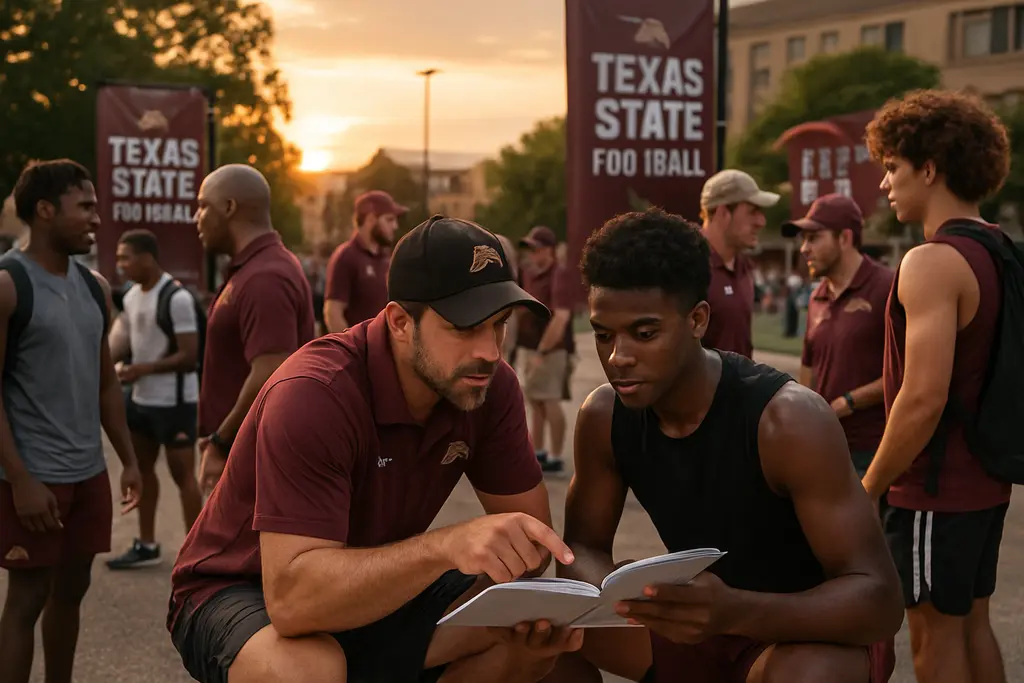

Texas State Recruiting entered a new phase after the Bobcats officially became a full Pac-12 member on July 1, 2026, completing the move from the Sun Belt into the conference’s 2026 relaunch ESPN reported. For San Marcos, that change has already shown up in the recruiting conversation. The 2027 class, expected to enroll for Fall 2027, was no longer built only around familiar in-state targets as of early July 2026. The Bobcats had started to pull more attention from outside Texas while still keeping a clear local foundation.
Texas State Recruiting Gains A Wider Map
The clearest early sign of the Pac-12 effect came in the geography of the 2027 commitment list. As of early July 2026, Texas State had 20 commitments in that class, including seven out-of-state recruits, the highest number of non-Texas prep commitments in the G.J. Kinne era Yahoo Sports reported. That number matters because it shows the staff has been able to keep its Texas base while reaching into new recruiting territory.
A commitment list in July is not a signed class, and the recruiting calendar can shift before prospects enroll. Still, the snapshot gives the community a useful read on how the Bobcats’ pitch has changed since the Pac-12 move became real. Texas State can now sit in living rooms and talk about a conference schedule with a broader footprint, more national visibility, and matchups that carry weight outside the state.
Texas State Recruiting Moves Beyond Texas
The seven out-of-state commitments in the 2027 group did not erase the program’s Texas identity. They expanded it. Texas State has long needed to win enough battles near home to keep San Marcos connected to the state’s high school pipeline. The new piece is that the Bobcats can pair that local pitch with a wider conference brand and a stronger case to prospects in places such as Louisiana, California, Arkansas, and Oklahoma, all of which were represented in the reported 2027 group.
That shift is meaningful for a program that has often had to sell opportunity before reputation. The Pac-12 label does not sign players by itself, but it gives coaches a different opening line. For recruits and families, it can make Texas State feel less like a regional option and more like a program trying to grow into a larger football stage while still offering a campus community close to Central Texas.
Why Daylon Gordon Stands Out
Running back Daylon Gordon of Wylie, Texas, gave the 2027 class its headline name. He was reported as a four-star prospect and ranked 22nd nationally among running backs, making him Texas State’s highest-rated recruit ever at the time of the Yahoo Sports report. That is a major marker for a program trying to prove the Pac-12 move can help attract players who may have drawn attention from bigger-name programs.
Gordon’s commitment also keeps the story rooted in Texas. The Bobcats are not building the class by stepping away from the state. They are trying to raise the level of the in-state wins while adding out-of-state depth. That balance will be important because San Marcos has to remain a credible destination for Texas high school players even as the schedule and recruiting conversations stretch west.
What The 2027 Class Says About Texas State Recruiting
The 2027 group was reported with one four-star prospect and 11 three-star prospects as of early July 2026. The three-star group included athletes, wide receivers, defensive linemen, and offensive linemen from multiple states. That mix points to a class built around both skill talent and line development, two areas that matter even more as the Bobcats prepare to measure themselves against Pac-12 opponents.
For local fans, the key is not just the number beside a player’s name. It is where those players fit. A conference move can create excitement, but weekly football still comes down to roster balance. Skill players may bring attention first, yet offensive and defensive line additions can decide whether a team can travel, protect the quarterback, and handle stronger fronts. The reported additions of linemen in the 2027 class showed that Texas State’s staff was not treating the move as a branding exercise only.
Position Variety Without Overstating The Class
The class had enough variety to suggest a broad approach, but it was still an early commitment group. That distinction matters. Recruiting rankings and commitment totals are useful reference points; they are not finished results. Prospects still had time before Fall 2027 enrollment, and class composition could change through signing periods, player decisions, and staff needs.
By late June 2026, Texas State had added five recruits that helped raise its 2027 class ranking to 76th nationally, according to the Yahoo Sports reporting. Those additions included three-star linebacker Kyle Horde, three-star offensive lineman Delonte Duff, three-star defensive lineman Antonio Underwood, and linemen Jaylen Haywood and Jayden Bradford. The presence of multiple front-seven and line names in that group gives the class a practical edge for a program facing stronger conference matchups.
A Sixth-Place Pac-12 Snapshot Still Carries Weight
At the time of the report, the 2027 class was sixth among Pac-12 schools in national recruiting rankings. That placement keeps expectations grounded. Texas State had made progress, but the Bobcats had not suddenly jumped to the top of their new league. The value of the ranking is that it frames the climb honestly: the program has improved its reach, yet it still has work to do against established conference peers.
That is why the San Marcos view should be both proud and clear-eyed. The Bobcats have secured commitments that would have stood out in their previous recruiting lane, and they have started to appear in more serious Pac-12 comparisons. The next step is turning early interest into signed players, development, and roster depth that can hold up through conference travel and physical weekly matchups.
Retention, Exposure, And The San Marcos Pitch

Recruiting is not only about adding names. It is also about keeping the right players in the program long enough to develop. The move to the Pac-12 raises the value of retention because Texas State will need experienced contributors who understand the staff, the practice standard, and the local culture around the team. A class with more star power helps, but continuity can keep a roster from becoming dependent on quick fixes.
The Texas State Recruiting pitch now includes more national television exposure, a wider conference map, and access to out-of-state prospects, according to the Yahoo Sports report. That can help the staff reach players who may not have taken the same call during the Sun Belt years. It also raises expectations inside the building. Once the program recruits against a larger group of peers, the development plan has to match the promise made during recruitment.
The Texas Base Still Matters Most
If seven of the 20 reported 2027 commitments were from outside Texas, the majority of the class still came from inside the state. That matters for community identity. San Marcos is not trying to become a distant outpost for a western league. It is trying to bring Texas high school talent into a Pac-12 setting while giving local fans a program that still feels connected to the region.
That balance should matter to families, high school coaches, and alumni across Central Texas. A recruit from Wylie, San Antonio, Austin, Houston, or the Hill Country should still see Texas State as a place where local ties can carry value. The difference now is that those same players can view the Bobcats as a pathway into a broader conference schedule without leaving the state.
How The Staff Can Use The New Profile
Texas State’s coaches can point to evidence rather than talk in general terms. They can show the July 1, 2026 Pac-12 membership date, the reported 20-player 2027 commitment list, the seven out-of-state pledges, and the four-star running back at the top of the class. Those are concrete recruiting markers. They do not guarantee wins, but they make the conversation more serious.
That context also connects with the program’s recent roster-building priorities. Our earlier look at 2026 class priorities showed how line questions and Texas-heavy depth were already part of the discussion before the Pac-12 move fully arrived. The 2027 class added another layer by showing that the Bobcats could stretch their reach while still chasing needs close to home.
What The Pac-12 Move Means For Texas State Recruiting
The Pac-12 move has given Texas State a bigger recruiting room, but it has not removed the need for patient player development. The 2027 class snapshot showed real progress: more out-of-state commitments than any previous prep class in the Kinne era, a four-star running back at the top, and a group that included multiple three-star prospects across key positions. It also showed that the Bobcats still had room to climb inside their new league.
For San Marcos, Texas State Recruiting now carries a different kind of local energy. The community can see the program being discussed in Pac-12 terms while still leaning on Texas players and Texas high school relationships. That is the path that makes the most sense for the Bobcats: keep the home base strong, use the conference move to widen the map, and turn higher-profile commitments into dependable college players.
The most important part is that the story is no longer theoretical. Texas State became a Pac-12 member on July 1, 2026, and the recruiting data from the 2027 class already reflected a broader reach by early July. The next measure will come as those commitments move through the signing process and, eventually, into the roster. For now, the Bobcats have given San Marcos a recruiting update worth following because it shows the conference move has started to change who is listening.