
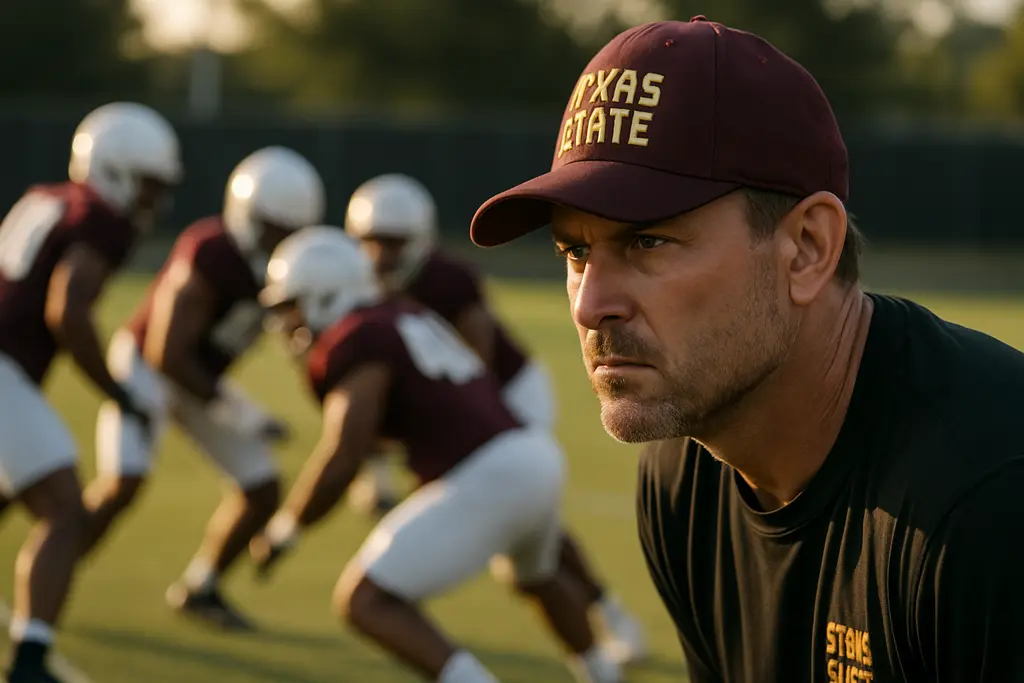

Texas State Coaching Changes became one of the clearest team-news stories in San Marcos on January 21, 2026, when head coach GJ Kinne announced three defensive staff additions: Will Windham as defensive coordinator, Marcus Patton as secondary coach and Chris Gistorb as defensive line coach, according to the official staff announcement. For a program that entered a new conference stage in 2026, those hires were not background moves. They were football decisions tied to tackling, pressure, coverage, player development and the weekly identity Texas State wants to bring into a larger competitive spotlight.
Texas State Coaching Changes Put Defense First
Texas State Coaching Changes Start With Windham
Windham’s arrival gave the Bobcats a defensive coordinator with recent Sun Belt results attached to his name. At South Alabama, his 2024 rushing defense allowed 142.8 yards per game, which ranked second in the Sun Belt, and Texas State reported that he also helped oversee a 2025 defense that ranked fourth in the league in pass yards allowed and total defense in the same Texas State release.
Those numbers matter because Texas State did not hire only a play-caller. The Bobcats hired a coach whose recent work connects directly to front-seven discipline and pass-defense structure. In plain football language, that means the new coordinator arrived with evidence of building a defense that could slow the run enough to make opponents earn yards in more predictable situations.
That is where the local piece comes in. San Marcos has watched Texas State football grow into a program with more attention, more expectation and more week-to-week scrutiny. A defensive change is not just a staff-card update for people around UFCU Stadium. It shapes how the team practices, how position groups are judged and how players hear accountability from Monday meetings through game-day adjustments.
Patton And Gistorb Bring Position-Specific Production
Marcus Patton’s background gave the secondary room a coach tied to pressure production from his previous stop. Before joining Texas State, Patton served as defensive coordinator at Sacramento State in 2025, where the Hornets led the Big Sky in sacks and tackles for loss and ranked in the top 10 nationally in both categories, according to Texas State’s staff release.
For a secondary coach, that detail is meaningful. Sacks and tackles for loss are not produced by the front alone. Coverage must hold long enough to let pressure arrive. Safeties and corners must communicate well enough to prevent easy answers. Patton’s task in San Marcos became teaching technique while fitting his group into Windham’s larger defensive plan.
Chris Gistorb’s path to Texas State pointed straight to defensive line development. He came from McNeese, where he coached a defensive line that included Phillip Bradford, a first-team All-Southland Conference honoree. Texas State also noted Gistorb’s 2023-24 work at Northwestern State, where he helped develop freshman All-American defensive lineman Chancellor Owens.
The strongest part of Texas State Coaching Changes on defense is how the three hires connect. Windham’s coordinator role sets the structure. Patton’s secondary work affects coverage and pressure timing. Gistorb’s defensive line coaching influences the first contact point of every snap. If those rooms grow together, the Bobcats can build more than a new call sheet. They can build a clearer defensive personality.
Why The New Defensive Voices Matter
Player Development Is The Daily Test
Coaching changes are often judged by Saturday results, but the work starts much earlier. The Bobcats’ new defensive staff had to teach language, standards and position details before any new conference measuring point could define them. That is a demanding assignment because players must absorb terminology while still playing fast.
Windham’s recent success against the run offers a useful clue about what Texas State may value under his direction: gap discipline, fits, pursuit angles and limiting free yards. Patton’s prior defensive production at Sacramento State points toward aggression and disruption. Gistorb’s record with individual defensive linemen suggests that technique development could be central to how the front grows.
None of that guarantees immediate results. It does give Texas State fans and local coaches a fair way to evaluate progress. Are missed tackles reduced? Does the line hold its gap when tempo rises? Do defensive backs communicate before the snap? Does pressure arrive without exposing the back end? Those are the questions that matter more than offseason praise.
Continuity Still Runs Through Kinne
Even with new defensive assistants, the program’s tone still runs through Kinne. The January 21 staff announcement came from a head coach making targeted changes at a moment when Texas State’s profile was rising. That balance is central to the story: the Bobcats adjusted one side of the ball without presenting the program as if it needed a full rebuild.
For the players, that can be a healthy structure. A new coordinator brings fresh demands, but the head coach’s program standard remains in place. For the San Marcos community, that creates a storyline worth following closely. This is not change for the sake of noise. It is a football staff trying to prepare a roster for sharper weekly tests.
That is also why roster depth entering Pac-12 play connects naturally to the coaching conversation. Depth is only valuable when players are trained well enough to step into roles with confidence. The new defensive staff’s impact will be felt not only with starters, but with the second wave of linemen, defensive backs and special-situation defenders.
How The Pac-12 Move Raises The Standard
Conference Change Turned Staff Fit Into A Bigger Question
Texas State’s move to the Pac-12 raised the stakes around every staff decision. The university announced that Texas State would join the Pac-12 Conference in fall 2026 through an official university newsroom release. By September 1, 2026, that move had already shifted the frame around the football program.
The Bobcats were no longer preparing for the same weekly identity they had known before. A new league brings different travel demands, different coaching matchups and a larger platform for every strong performance or breakdown. That does not mean the previous work becomes less valuable. It means the translation of that work becomes the story.
Windham, Patton and Gistorb all arrived with production attached to prior jobs. The next question is how those habits carry into Texas State’s Pac-12 reality. A defense that tackles cleanly and communicates with confidence can travel. A front that wins early downs can help an offense avoid playing from pressure. A secondary that limits missed assignments gives the whole sideline more stability.
Local Expectations Are No Longer Quiet
Texas State football has always mattered to San Marcos, but conference realignment changed the volume. A staff change in January was not only an internal move. It became part of how students, alumni, families and local sports voices talked about the Bobcats’ direction.
For people who fill the parking lots, follow spring development and track position battles, Texas State Coaching Changes were a sign of how serious the program viewed defense entering the Pac-12 era. The hires told the community that Texas State wanted more than momentum from realignment. It wanted coaching structure that could support stronger football.
There is a human side to that, too. Assistant coaches spend hours with position rooms, young players and families who trust the program’s development process. A defensive line coach can shape confidence for a redshirt freshman. A secondary coach can help a corner handle one bad snap without losing the next one. A coordinator can define whether a unit responds to pressure with clarity or panic.
What Texas State Coaching Changes Mean For San Marcos
Texas State Coaching Changes are less about one press release and more about the next phase of Bobcat football. The January hires gave the defense three new voices with documented production at previous stops. Windham brought recent Sun Belt defensive results. Patton brought pressure-based success from Sacramento State. Gistorb brought defensive line development from McNeese and Northwestern State.
For San Marcos, the impact is practical. A better-organized defense can keep home crowds engaged deeper into games. Stronger player development can help local supporters recognize growth from week to week. Clearer coaching roles can help the Bobcats build the kind of identity that travels beyond Central Texas without losing the community edge that makes the program feel personal.
The safest reading is also the fairest one: these hires gave Texas State a stronger defensive plan on paper, but the proof had to come through tackling, communication and player growth after the staff arrived. In a Pac-12 setting, the margin for loose technique narrows. That is why these moves carried real weight before the first full measure of the new era could be written on the field.
Texas State’s future will not be decided by staff titles alone. It will be shaped by whether those coaches turn résumés into repeatable habits for the players wearing maroon and gold. That is the part San Marcos will feel most: not the announcement date, not the job labels, but the weekly evidence of a team being coached to meet a bigger moment.