
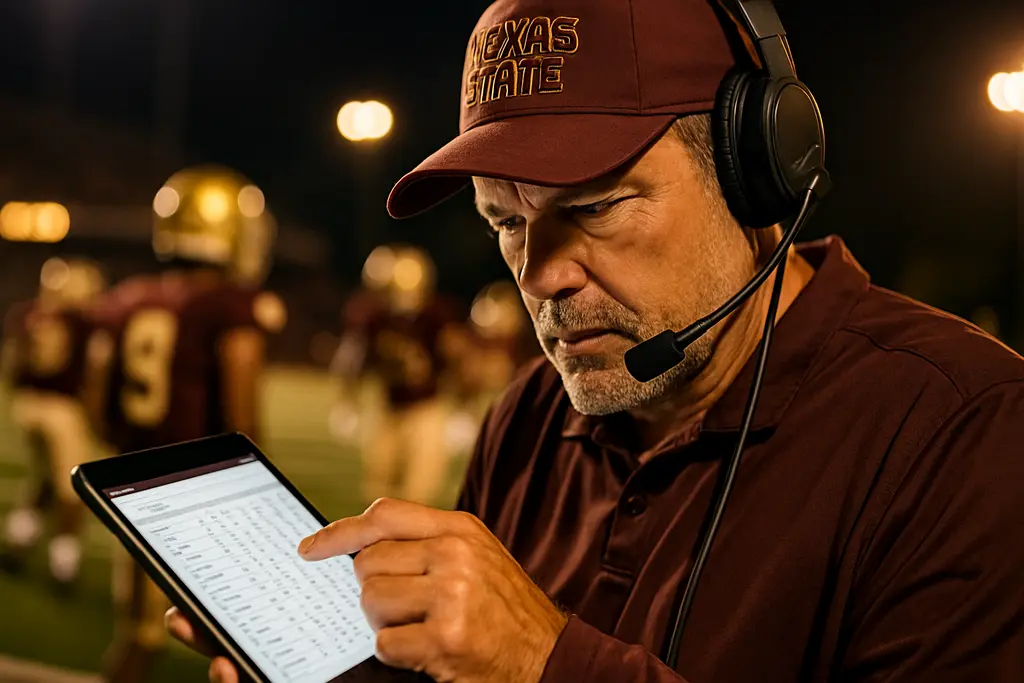

Texas State transfers became one of the clearest roster-building tools for G.J. Kinne’s staff in 2026, not as a side piece to high school recruiting but as a direct answer to immediate depth needs. The Bobcats announced 19 student-athletes after the January 2-16, 2026 Transfer Portal window, while also building from 19 high school signees from the December 3-5, 2025 Early Signing Period, according to Texas State Athletics. For a San Marcos program trying to keep momentum in a higher-profile football setting, that split tells the real story: the roster was built through both long-term development and players expected to compete quickly.
How Texas State transfers Changed The Roster Math
Texas State transfers And Immediate Competition
The portal class mattered because it changed the number of playable options across the roster. January additions gave Texas State more bodies in position rooms where spring and preseason reps can decide the two-deep. That does not guarantee a transfer walks into a starting job, but it does raise the standard in practice. A returning player now has to defend his snaps against an older newcomer who has already been through college weight programs, meeting rooms and road environments.
That approach fits the stage Texas State entered in 2026. The Bobcats were not simply filling a few scholarships after graduation. They were balancing high school signees, returning production and transfer experience while preparing for a schedule with greater travel demands and more national attention. In that setting, a January portal window can become the difference between having one trusted option at a position and having three players capable of handling game-week work.
Why January Timing Mattered
The timing of the portal additions was important for roster installation. Players added in January had a chance to enter offseason conditioning, learn terminology and compete before fall decisions tightened. That is especially valuable for linemen, quarterbacks and defensive front players, where physical development and system comfort are often harder to speed up once games begin.
For local supporters in San Marcos, the transfer class also gave spring and summer conversations more substance. Roster talk shifted from general optimism to position-by-position evaluation: who could protect the quarterback, who could pressure opposing passers, who could create depth behind returning skill players, and how quickly the new arrivals could fit into the program’s pace.
Quarterback Depth Became A Portal Talking Point
Shaker Reisig Adds Another Evaluation Layer
Quarterback was one of the most watched rooms because every roster move there tends to draw attention. Shaker Reisig transferred from Boston College to Texas State after committing on January 11, 2026. He appeared in three games for Boston College in 2025, throwing for 141 yards with one touchdown and two interceptions, as reported by Sports Illustrated. Those numbers do not define his long-term ceiling, but they do give Texas State another quarterback with recent Power Four game exposure.
The value of that move is not limited to a depth chart label. Quarterback competition affects the whole offense. Receivers adjust to timing, offensive linemen respond to cadence, and coaches learn which passers process pressure best during team periods. With Texas State transfers entering several position rooms, the quarterback spot became part of a wider roster reset rather than a single-name storyline.
Competition Without Guesswork
It would be unfair to declare a final quarterback order without verified staff decisions. What is supported is that Reisig’s arrival added another option to a room that had already seen movement. That matters for practice structure. More legitimate competition means more meaningful reps, more film for coaches and fewer assumptions about who can run the offense when the schedule tightens.
For a community that has watched Texas State’s recent football rise closely, quarterback depth is not an abstract recruiting note. It affects Saturday confidence at UFCU Stadium, the rhythm of the offense and the way fans read every drive. A transfer quarterback with prior college snaps gives the staff another player to evaluate under pressure, even if the final role has to be earned on the field.
Line Additions Point To A Physical Roster Plan
Offensive Line Help Was Part Of The Build
Texas State’s portal work also showed a clear interest in line depth. William Boone arrived from North Carolina after playing three games for UNC in 2025 before taking a medical redshirt, per Texas State’s January announcement. That type of addition gives the Bobcats a player with high-level training background and time to grow into the room, while still leaving the coaching staff to evaluate health, conditioning and fit through practice.
Offensive line development rarely gets the loudest reaction on signing day, but it often shapes what an offense can actually become. A deeper line room can help protect the quarterback competition, support the run game and give coaches flexibility if injuries or performance changes force adjustments. For Texas State, adding Boone was less about public buzz and more about building enough experienced options to survive a demanding college season.
Defensive Front Turnover Needed Answers
The defensive line also drew attention in the transfer cycle. Kaleb James joined from Arkansas as part of the January group announced by Texas State. His arrival fit a broader need for size, competition and rotational strength up front. Defensive line play can decide whether a defense gets off the field on third down, keeps linebackers clean and avoids wearing down late in games.
Portal recruiting is especially useful on the defensive front because high school linemen often need time before they are ready for major snaps. Transfers can arrive with college strength work already behind them. That does not make them finished products, but it can shorten the wait for usable depth. In Texas State’s case, the staff used the portal to address both sides of the line, a sign that the roster plan was built from the trenches outward.
How The Portal Class Fits Returning Leaders

Transfers Did Not Replace The Whole Core
The roster story is not simply new arrivals replacing everyone already in San Marcos. Transfers matter most when they raise competition around a returning core. That balance is central to Texas State’s 2026 build. A team that leans only on newcomers can lose continuity; a team that ignores the portal can lack instant answers in thin rooms. The Bobcats tried to work between those extremes.
Returning leaders still shape the standard inside the facility. Transfers can add talent, but returning players carry knowledge of practice tempo, staff expectations and local identity. That is why the best roster fits are not always the biggest names. They are the players who accept the culture quickly, compete without disrupting the room and give coaches reliable choices when games demand rotation.
Position Rooms To Watch In San Marcos
Based on the verified additions and the roster needs implied by the January class, several areas stood out as the most affected by transfer movement:
- Quarterback: Reisig’s arrival gave Texas State another passer with recent college game experience.
- Offensive line: Boone added another option to a room where depth is often tested over a full season.
- Defensive line: James brought another college-trained body into a position group that needs rotation strength.
- Development pipeline: The transfer group worked alongside a full high school signing class, creating short-term and long-term competition.
For readers tracking how those January additions fit the wider recruiting plan, our breakdown of the January portal adds connects this class to the broader roster build.
What Texas State transfers Mean For San Marcos
A Local Roster Story With Bigger Stakes
Texas State transfers are not just a recruiting headline for message boards. They affect how San Marcos experiences football Saturdays. Deeper competition can improve practice quality, create stronger special teams units and give the coaching staff more choices when matchups call for different personnel. That matters to students, alumni and families who have watched the Bobcats push for a stronger place in Texas college football.
The portal also changes how fans learn the roster. A high school signee may take two or three years to become familiar on game day, while a transfer can become part of the rotation almost right away. That speeds up the connection between recruiting news and stadium conversation. Names from Boston College, North Carolina and Arkansas are no longer distant college football references; they are part of the San Marcos depth chart discussion.
The 2026 Roster Was Built For Competition
The safest read on the 2026 roster is that Texas State used the portal to create competition, not certainty. The official January class showed real volume. Reisig brought quarterback experience from Boston College. Boone added another offensive line option from North Carolina. James gave the defensive front another transfer from the SEC. Those are verified pieces of the build, and each points to a staff intent on making position battles deeper.
The next measure has been performance, not signing-day reaction. Transfers have to learn the system, earn trust and handle the week-to-week demands of Texas State football. Still, the roster construction is clear: the Bobcats used both the high school class and the portal to build a 2026 team with more competition across key rooms. For San Marcos, that made the transfer class one of the central stories of the football year.