
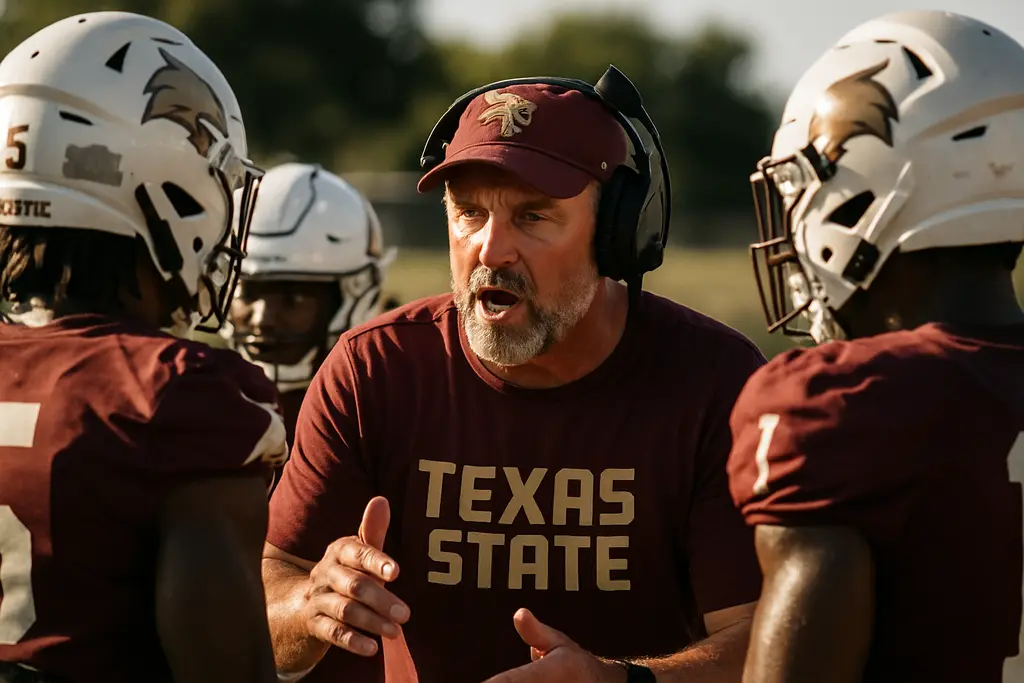

Texas State Coaching has taken on a sharper player-development focus in 2026, with staff changes, facility upgrades and roster-building choices all pointing toward a more structured plan in San Marcos. As of September 28, 2026, the clearest shift sits on defense, where G.J. Kinne’s January staff additions were aimed at improving a unit that needed a new teaching voice after a difficult 2025 season.
Texas State Coaching Starts With Defensive Repair
Why Texas State Coaching Changed On Defense
On January 21, 2026, Texas State hired Will Windham as defensive coordinator, Marcus Patton as secondary coach and Chris Gistorb as defensive line coach. That group arrived with a clear assignment: raise the defensive standard before the Bobcats faced a larger conference challenge. The move was not cosmetic. The 2025 defense allowed 29 points per game across the full season, and that number rose to 36 points per game in Sun Belt play, according to the research notes provided for this report.
Windham’s background matters because it matches what Texas State needed most: teaching range. He spent five seasons at South Alabama, including defensive coordinator duties in 2024 and 2025, after previous stops that included linebackers work and experience at Kent State and Georgia. The staff’s stated value in Windham centered on scheme flexibility and his ability to connect with players, which is especially relevant for a roster moving through conference transition.
For San Marcos, the most meaningful part of the change is not just who calls plays. It is how the defensive room gets taught during the week. A coordinator with linebacker roots can influence run fits, communication and second-level discipline. A dedicated secondary coach gives the back end a clearer development lane. A defensive line coach with experience developing high-level players can help set daily standards for hands, pad level and rotation depth.
The Defensive Staff Has To Build Trust Quickly
Player development depends on repetition, but it also depends on belief. A new defensive staff cannot simply install calls and expect immediate improvement. The Bobcats needed coaches who could teach, correct and keep players invested after a year when conference opponents scored too often. That is where the Patton and Gistorb hires fit the broader plan. Their value is tied to position-specific growth, especially in rooms where technique and confidence often determine whether a defense survives long drives.
The defensive reset also affects recruiting. Prospects and transfers do not only ask about depth charts. They want to know how a staff plans to make them better. A defense that can point to role clarity, position coaching and a coordinator with multiple scheme backgrounds has a better player-development story to tell Texas high school athletes, junior college players and portal targets.
Specialized Roles Make Development More Personal
Staff Depth Matters Past The Coordinator
The 2026 football staff structure included a Player Development Coordinator / Running Backs Assistant role held by Lincoln Pare, along with analysts, graduate assistants and a strength and conditioning group led by Bret Huth. That structure shows how Texas State is trying to move beyond a top-heavy coaching model. The more teaching points a program can create during practice, film review and individual work, the more likely players are to receive feedback before bad habits harden.
That is especially important in a roster room built from several paths. Texas State has worked with high school signees, junior college transfers and portal additions under Kinne. Those players arrive with different training backgrounds and different timelines. A freshman may need weight-room development and position basics. A junior college transfer may need faster system learning. A portal player may need role adjustment rather than a full rebuild. Texas State Coaching has to meet each group without reducing the standard for any of them.
The football staff’s added layers also fit a wider athletic department direction. Texas State’s 2023-2029 plan called for improved strength and conditioning resources, fairer athletic training staff models across sports, competitive salaries to reduce coach turnover, facility development and added coaching positions tied to NCAA changes, according to the university’s athletics priorities plan. That document gives context to the coaching moves: development is not being treated as a slogan, but as an operating target.
Baseball Shows The Same Development Pattern
The development theme was not limited to football. On August 13, 2026, Texas State promoted Austin Huml to Director of Hitting Development for baseball after he previously served as a student assistant. The title itself is notable. It points to a more formal approach to swing work, hitting plans and player growth inside the program.
The timing also mattered. Texas State baseball’s offense recorded 116 home runs during the 2026 season, a program record and a Sun Belt single-season record, according to the research notes. A single statistic cannot explain every part of a hitter’s growth, but it does show that the program’s offensive environment had already produced measurable power gains before Huml’s promotion. In local terms, that matters because Bobcat fans have seen player development become part of the school’s identity across sports, not just inside the football complex.
Facilities Give Coaches More Daily Teaching Time
Training Space Meets Meeting Space
Facility investment is often discussed through recruiting photos and ribbon-cutting moments, but its real value shows up between practices. In October 2025, Texas State completed a $37 million South End Zone Complex expansion at UFCU Stadium, including an 8,000-square-foot weight room, players’ lounge, training area, team meeting rooms and upgraded locker rooms, as detailed in a Hillviews Magazine report. Those spaces give coaches more chances to turn daily routines into teaching periods.
The study lounges included in the project also matter. A player-development plan that ignores academics usually falls short, especially in college sports where eligibility, time management and personal growth sit beside performance. Study space near football operations can make academic support easier to access and harder to separate from the team’s daily rhythm.
For a local program in San Marcos, that helps Texas State compete in a practical way. The Bobcats may not sell every recruit on tradition alone, but they can show a player where he lifts, studies, recovers, meets with coaches and builds relationships. That has recruiting value because it makes the development pitch visible.
Roster Building Connects Recruiting And Teaching
Balance Has Replaced Portal Dependence
Kinne’s roster approach in early 2026 moved toward a better balance between high school athletes, junior college players and select portal additions. The research notes show that Kinne has said Texas State is no longer fully reliant on the portal. That shift is significant because development works best when a staff is not forced to rebuild the roster from scratch every cycle.
High school recruiting gives coaches time to shape bodies, habits and position skills. Junior college recruiting can add maturity and competition. Portal recruiting can answer urgent needs, but it works best when it supplements a core rather than replacing one. That is why roster construction and coaching structure now feel linked in San Marcos. For more on how roster pressure fits the Pac-12 move, our recent breakdown of Texas State rosters connects those personnel choices to the next competitive stage.
Texas State Coaching now has to prove that balance on the field. Defensive improvement will be the first public marker, but the deeper evaluation will come from player growth: young linemen adding strength, defensive backs communicating faster, running backs improving pass protection and transfers fitting into team standards without slowing the room.
Why Texas State Coaching Matters In San Marcos
The local stakes are clear. Texas State is trying to build a program that can recruit Texas, retain its best developmental players and give San Marcos a team with a stable identity. The new defensive staff, specialized support roles, baseball hitting-development move and facility investment all point in the same direction: more teaching, more structure and more accountability.
Texas State Coaching will not be judged by titles alone. It will be judged by whether players improve from January to September, whether position rooms become deeper, and whether the Bobcats can match their larger platform with sharper weekly habits. For a community that has watched the program push for higher visibility, that is the part worth tracking most closely.