
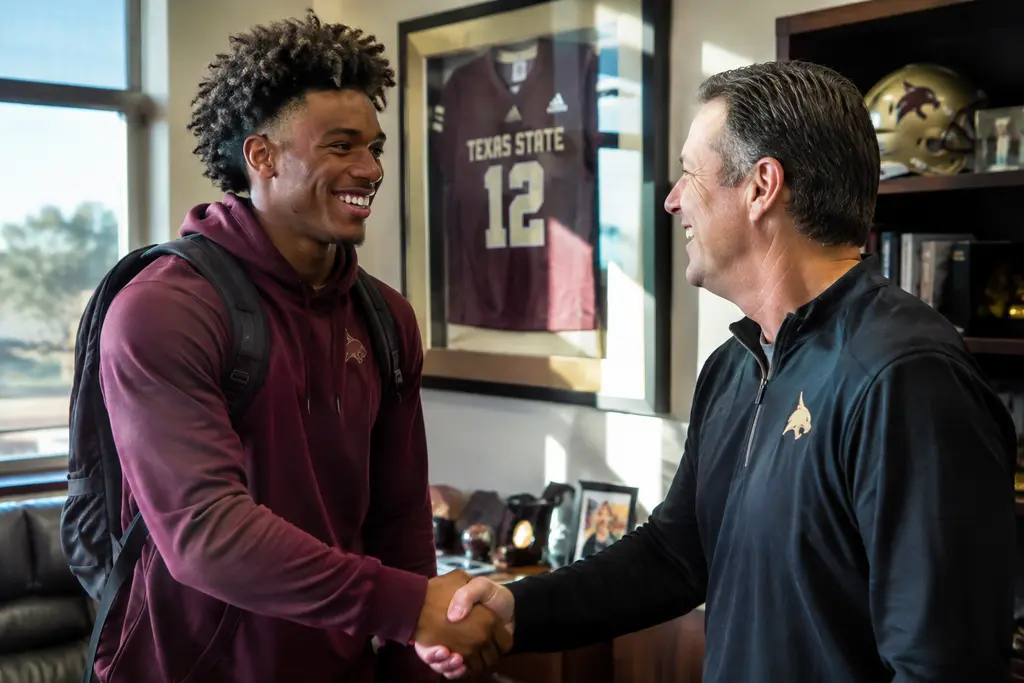

The Daylon Gordon commitment gave Texas State football one of its clearest recruiting wins of the 2027 cycle. Gordon, a running back from Wylie High School in Wylie, Texas, verbally committed to the Bobcats on June 9, 2026, as part of the Class of 2027, according to Yahoo Sports. For a San Marcos program trying to keep more Texas high school talent close to home, the decision mattered beyond one position group.
Why The Daylon Gordon Commitment Matters In San Marcos
Daylon Gordon Commitment And The In-State Signal
The Daylon Gordon commitment stood out because it came from a Texas high school player at a position that often defines offensive identity. Wylie is part of the Dallas-area talent base, and Gordon’s decision gave Texas State another reason to keep pressing into high school programs across the state. For the Bobcats, this was not just about adding a name to a list. It was about winning a recruitment that connected directly to local pipeline building.
Yahoo Sports reported that Gordon’s decision came despite offers or strong interest from programs including Texas Tech, Florida State and Baylor. That matters in recruiting terms because Texas State did not simply take a player overlooked by larger programs. The Bobcats earned a verbal pledge from a back who had attention from schools with broader national profiles.
That kind of win can help a staff in two ways. First, it gives coaches a player to point to when speaking with other Texas prospects in the same class. Second, it adds credibility to the message that staying in state does not have to mean giving up visibility or development opportunity. San Marcos has to sell both football fit and community fit, and Gordon’s pledge gave that pitch a real example.
What Wylie Production Says About Fit
Gordon’s production explains why Texas State viewed him as more than a depth piece. Through two high school seasons, he had 1,806 rushing yards and 15 rushing touchdowns, along with 52 catches for 753 yards and four receiving touchdowns, according to Yahoo Sports. That receiving total is especially useful for evaluating his fit because it shows involvement beyond traditional carries.
Texas State has recruited him as a running back, but those receiving numbers suggest he can be used in ways that stress linebackers and safeties. A back who can catch the ball out of the backfield gives an offense more options on early downs, third downs and tempo situations. That does not guarantee an immediate college role, but it does show why his high school résumé attracted attention.
Player Profile: Size, Production And Backfield Fit
Frame And Recruiting Profile
Gordon is listed at 5 feet 9 inches and 195 pounds on his On3/Rivals profile. That build points to a compact running back frame, with enough listed weight to handle contact while still leaving room for college strength development. Recruiting services can differ on rankings, and the research around Gordon reflects that range. He has been rated around the four-star line by some services, while broader national listings have placed him around the mid-300s to low-400s nationally and around the low-30s among running backs.
Those numbers should be read with care. Recruiting rankings are useful context, not a finished evaluation. What matters for Texas State is that Gordon already had production, a defined position, and a measurable skill set before his senior high school season. The Bobcats can build a long-term backfield plan around a player who has shown both volume rushing value and passing-game use.
Receiving Value In The Bobcats’ Offense
The receiving production is the trait that makes Gordon’s profile especially interesting for roster planning. A running back with 52 catches through two high school seasons has already been asked to track the ball, work in space and contribute outside basic handoff duties. That kind of background can speed up a player’s adjustment to college offensive meetings because the passing game is not a new assignment.
For Texas State, the projection is not about declaring a role before Gordon arrives. It is about adding a recruit whose high school profile gives the offensive staff more flexibility. He could fit into traditional run concepts, screen looks, motion packages or passing-down work if his development follows the path his production suggests. The Bobcats’ staff still has to evaluate him through future practices, strength work and competition, but the early profile gives them a useful foundation.
Recruiting Class Context For Texas State
Class Momentum After June 9
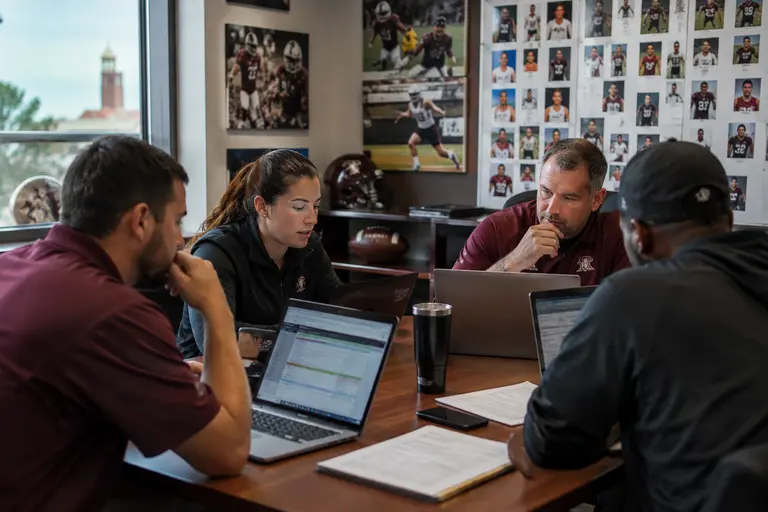
The Daylon Gordon commitment landed during a larger June push for Texas State’s 2027 class. Yahoo Sports reported that Texas State added six commits to that class and that the group included four three-star prospects. After Gordon’s addition, the Bobcats’ 2027 class was reported in the national 60s, around No. 62, and second in the Pac-12 at that time.
Recruiting rankings shift as classes grow, players move, and evaluations update, so that number should not be treated as permanent. Still, the placement mattered at the moment because it showed Texas State gaining traction against conference peers and against programs recruiting the same Texas footprint. For fans in San Marcos, that is the key community angle: the Bobcats are trying to make the local and regional talent base feel connected to the next stage of the program.
For more local context on the same recruitment, our Daylon Gordon commitment profile also framed the pledge around running back depth and in-state recruiting value.
Why The Pac-12 Ranking Matters Locally
Being listed second in the Pac-12 at that point in the 2027 cycle gave Texas State a recruiting talking point, but the larger value is practical. A strong class ranking can help a staff get into more conversations earlier. Players notice who is building momentum. High school coaches notice which college staffs are organized, present and serious about local relationships.
The Bobcats still have to turn verbal pledges into signed players. Gordon’s commitment remained a verbal one as of the research date, and verbal commitments are not binding. That uncertainty is part of every recruiting cycle. Even so, the timing helped Texas State because a June 2026 pledge from a notable in-state back allowed the staff to recruit around him for the rest of the 2027 cycle.
What Daylon Gordon Means For Texas State Recruiting
A Local Recruiting Win With Roster Planning Value
The Daylon Gordon commitment gave Texas State a player with production, size, and multi-use offensive value. His rushing totals show a back capable of carrying workload. His receiving totals show a back who can be involved without the offense being limited to standard run calls. His recruitment also gave the Bobcats a visible Texas win at a time when every in-state success carries extra weight.
For the community around Texas State football, this is the type of recruitment that feels tied to identity. San Marcos has to compete with larger brands, but it also has a local case to make: Texas players can stay within the state, play in a growing program and help define what the Bobcats become next. Gordon’s pledge fit that message cleanly.
The next step is retention through the signing process and continued development once he reaches college football. Nothing in recruiting is complete until paperwork is signed and the player joins the roster. Still, based on the verified record available on November 4, 2026, Gordon’s decision gave Texas State a meaningful backfield addition and a recruiting result that should matter to fans across Central Texas.