


Texas State Recruiting has a cleaner sales pitch after the Bobcats’ 2025 finish: proof of offensive production, a decisive bowl win and a Pac-12 badge that changed conversations around San Marcos. The record still left clear roster questions. Texas State went 7-6, finished 3-5 in conference play, scored 36.5 points per game and allowed 29.0 points per game, according to Sports-Reference’s 2025 team page.
Why Texas State Recruiting Starts With 2025 Performance
The 2025 season gave G.J. Kinne’s staff two different messages to take into living rooms, high school offices and transfer conversations. One message was positive and easy to sell: the Bobcats could score. A team that averaged 36.5 points per game and ranked 12th of 136 FBS teams in that category had evidence that offensive players could produce in San Marcos.
The second message was more direct. The defense allowed 29.0 points per game, ranking 95th of 136. That number does not erase the winning moments, but it points toward why roster construction could not be built only around skill-position flash. Texas State needed to use its 2026 plan to support the front, improve defensive depth and keep enough offensive line stability to protect the system that made the scoring numbers possible.
Texas State Recruiting And The Offensive Pitch
For Texas State Recruiting, those figures create a practical pitch. Quarterbacks, wide receivers, backs and offensive linemen can see that the offense produced at a high national rate in 2025. That matters because recruits are rarely choosing only a school name. They are choosing a staff, a system and a realistic path to development.
The Armed Forces Bowl result sharpened that message. Texas State beat Rice 41-10 to close the 2025 campaign, giving the staff a postseason example that could be used without stretching the truth. Bowl wins help in recruiting because they give prospects and families a shared reference point. The staff can point to preparation, execution and a final result against an in-state opponent rather than leaning only on projections.
Where The Defense Shapes The Class
The defensive side is where the recruiting plan becomes less about slogans and more about roster math. A program giving up 29.0 points per game has to ask where the pressure, tackling, rotation strength and late-game stamina can improve. That does not mean every defensive problem sits on one position group. It does mean the 2026 approach has to treat defensive line, second-level range and back-end depth as connected pieces.
For local families and Texas high school coaches, that creates a different kind of opportunity. A high school defender who fits the staff’s size, speed and effort profile can look at the depth chart and see a program that has both momentum and need. That combination can be powerful when the player wants a real chance to compete rather than sit behind a loaded position room for years.
The Roster Message Behind The Numbers
Performance data rarely tells the whole recruiting story, but it does help explain what a staff emphasizes. Texas State’s 2025 offense gave the Bobcats credibility. The defense gave the staff a set of needs. The 7-6 record placed the program in a middle space: successful enough to sell progress, not complete enough to pretend the roster was finished.
That middle space can be useful. If a program is honest, it can tell recruits exactly where they fit. The strongest sales pitch is not always, “We have everything.” Often, it is, “We have proof that this is working, and we have a clear role that matches your skill set.”
Retention Matters As Much As Additions
Recruiting is no longer only about who signs in December or arrives through the portal. Retention is part of roster building. For Texas State, keeping key linemen and experienced contributors matters because the Pac-12 step placed the Bobcats against deeper weekly competition. New players help, but a staff cannot replace chemistry on both lines every cycle and expect the same timing, calls and physical edge.
That is why recent performance affects the 2026 plan in two ways. First, it gives the staff evidence to attract new talent. Second, it tells returning players that staying in San Marcos can still lead to bigger stages. For a program trying to keep a Texas identity while entering a larger conference setting, that internal message may be just as important as the external one.
Three Practical Priorities
The supported numbers point to three practical roster priorities for the Bobcats:
- Protect the offensive identity that produced 36.5 points per game in 2025.
- Use defensive needs as a clear path-to-playing-time message for front-seven and secondary targets.
- Keep the class rooted in Texas relationships while leaving room for system-fit prospects from outside the state.
For a related view of position planning, our breakdown of Texas State recruiting priorities tracks how the 2026 class connects to Pac-12 preparation.
How Texas State Recruiting Uses The Pac-12 Move
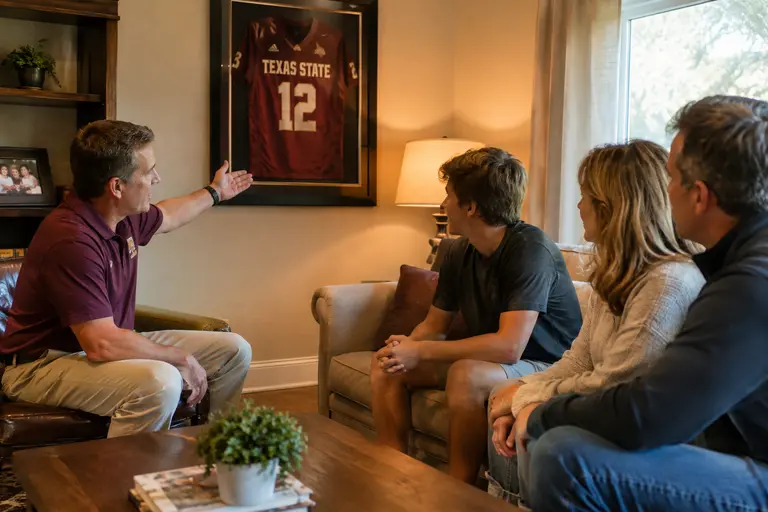
Texas State officially joined the Pac-12 on July 1, 2026, and that move changed the recruiting conversation even before every roster question had been answered. The Bobcats could now pitch a wider conference platform, more recognizable opponents and a schedule that reaches beyond the program’s previous footprint.
The Texas State Recruiting pitch can now combine three ideas: stay close to home, play in a higher-profile league and help define what the Bobcats become in their new conference home. That is a different pitch from asking players to believe in growth that no one has seen yet. The 2025 bowl result and the Pac-12 move give the staff tangible proof points.
Why The Texas Base Still Comes First
Kinne’s recruiting identity has stayed tied to the state. A Yahoo Sports report described his continued reliance on Lone Star State recruiting and noted that eight of the program’s ten highest-rated 2026 pledges came after the Pac-12 move became part of the pitch. That does not mean the Bobcats stopped evaluating outside Texas. It means the local pipeline remained the base.
That matters in San Marcos because Texas State sits between major high school football areas. Austin, San Antonio, Houston, the Hill Country and Central Texas programs all sit within realistic recruiting reach. A staff that wins trust in those rooms can build a class without asking every prospect to leave the state for national exposure.
Class Rankings Need Careful Reading
The available research described Texas State’s 2026 class as competitive within the newly aligned Pac-12 but not as a blue-chip-heavy haul. That distinction matters. The Pac-12 label can help get calls returned and visits scheduled, but it does not automatically create a roster filled with four- and five-star signees.
The more realistic read is that the Bobcats improved perception while still needing evaluation wins. They have to identify players who fit the offensive pace, defensive needs and developmental structure in San Marcos. If those evaluations hit, the class can outperform its star profile. If they miss, the conference move alone will not cover the gaps.
What Texas State Recruiting Means For San Marcos
Texas State Recruiting in 2026 is not just a staff-room exercise. It affects how San Marcos sees the program. A Texas-heavy roster gives local fans more players with high school connections across the state. It gives families from nearby communities a reason to travel to UFCU Stadium. It also gives high school coaches a clearer reason to stay engaged with the Bobcats as the program adjusts to Pac-12 competition.
The 2025 season gave the staff a usable blueprint and a warning. The offense showed recruits that the system can generate production. The bowl win gave the program a strong postseason clip to point toward. The defensive ranking showed where the roster still had to improve.
That combination should shape every recruiting conversation tied to the 2026 plan. Texas State can sell progress without pretending the job is finished. It can sell Pac-12 opportunity without cutting loose from the Texas high school base. It can sell playing time without lowering the standard needed to compete in a deeper league.
For San Marcos, that is the real recruiting story. The Bobcats are not trying to copy another program’s identity. They are trying to turn recent results into a roster that fits their own city, their own staff and their new conference challenge.