
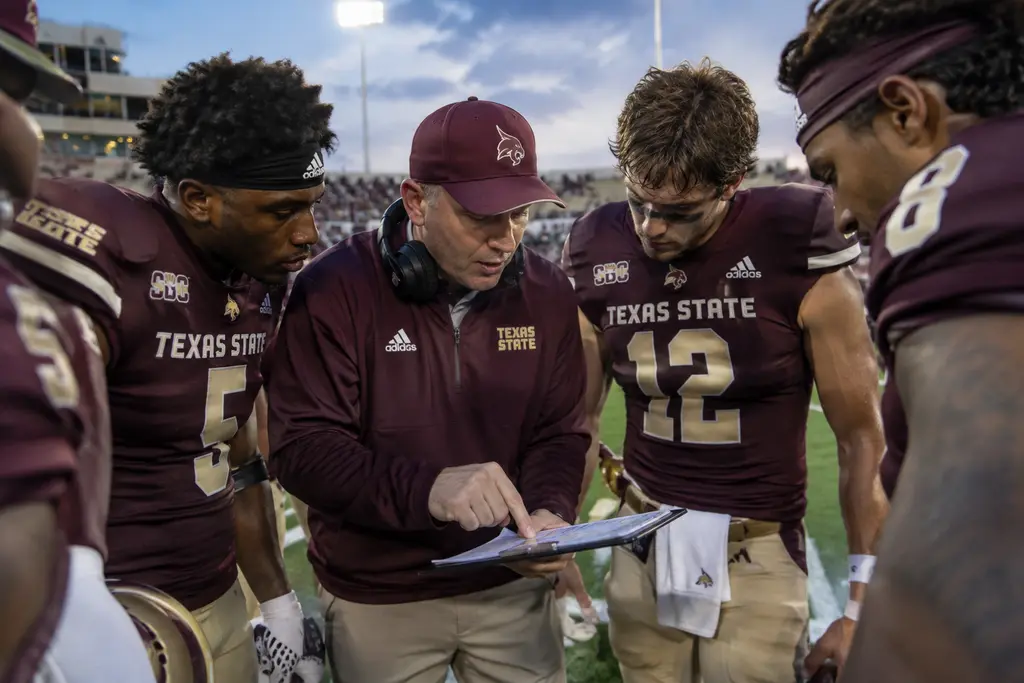

Texas State depth chart movement became more meaningful after the Bobcats handled a tense Homecoming assignment on October 24, 2026. Texas State defeated Utah State 20-17 in front of the Homecoming crowd, a result that moved the Bobcats to 4-3 overall and 2-1 in Pac-12 play, according to the official Texas State game recap. For a San Marcos program trying to turn conference life into week-to-week stability, the roster story after that win is not just about who started. It is about which roles appear to be earning staff trust as the schedule tightens.
Texas State depth chart Changes After Homecoming
The clearest post-Homecoming read is that Texas State did not need a sweeping public reset to make the roster worth studying. The changes that matter most are targeted: one at outside receiver, one at cornerback, and one at tight end. Those positions shape how the Bobcats create explosive chances, defend space and build packages for short-yardage or red-zone situations.
Texas State depth chart Signals Are Specific
The public chart tracked by TWO·DEEP listed Beau Sparks as the first-team WR-X above Kylen Evans on October 23, 2026, one day before the Utah State game. The same chart showed earlier movement with Amarion Atwood into the first-team CB1 spot and Blake Smith into the top tight end role on September 26, 2026, on the Texas State Bobcats depth chart. Those are narrow changes, but narrow changes often carry the most useful meaning for roster evaluation.
The reason is simple: a depth chart is not a box score. It does not tell us every snap, every personnel grouping or every in-game adjustment. It does, however, tell us how the program is publicly organizing its position groups. After a three-point Homecoming win, those designations matter because the margin for error remains small. A first-team label at WR-X, CB1 or TE1 suggests a player is being placed in a role that affects how the entire unit is built.
That is where local fans can read between the lines without inventing anything. A Homecoming crowd saw a close win. The official record now shows Texas State at 2-1 in league play after October 24. The roster card shows several players with elevated or confirmed first-team roles. Together, those facts point to a team still sorting its best combinations while staying competitive in its new conference schedule.
Receiver Movement Shows Trust In Beau Sparks
Beau Sparks’ move to first-team WR-X is the most direct offensive headline. The X receiver is often the boundary-side option asked to win isolated matchups, handle physical coverage and give the quarterback a defined target when the offense needs structure. The public move above Kylen Evans, listed on October 23, does not by itself describe every route or target. It does show that Sparks’ standing in the receiver room had changed before the Utah State result became part of the season record.
Why The WR-X Spot Matters
For Texas State, the WR-X label is not cosmetic. If the Bobcats are playing close Pac-12 games, an outside receiver who can command defensive attention helps the staff keep the full route tree available. It can also open space for inside receivers, backs releasing into the flat, and tight ends working underneath. A promoted receiver can change how the defense aligns before the ball is snapped.
That is why this Texas State depth chart note deserves attention beyond the name switch. Sparks’ first-team listing gives the offense a cleaner public hierarchy at a premium spot. Evans remains part of the position picture based on the chart context, but the listed order now puts Sparks first at WR-X. For a community that follows practice buzz, game-day body language and Saturday usage closely, that is the kind of shift people in San Marcos notice quickly.
There is also a continuity angle. Texas State did not need to change quarterbacks in the public information provided to explain this particular adjustment. The staff appears to have refined the receiver structure around the existing offensive operation. That can be a sign of role specialization rather than disruption. In roster terms, the question is not simply who is better. It is who fits the assignment the staff wants from that side of the formation.
For readers tracking past movement in this position group, the current picture also connects naturally with earlier roster discussion around Texas State depth chart shifts after previous home action. The through line is that receiver roles have been one of the clearest areas where the staff’s weekly preferences can show up.
Defense And Tight End Roles Carry Local Weight
Amarion Atwood’s move into the first-team CB1 spot, shown on the September 26 chart, gives the defensive side its own meaningful marker. Cornerback is a trust position. A CB1 is not just another starter label; it often means a player is being asked to handle difficult space, tackle in the open field and survive repeated tests from opposing quarterbacks.
Atwood And The Cornerback Picture
Texas State’s win over Utah State was decided by three points, so defensive roles deserve extra attention. Close games tend to magnify cornerback snaps because one missed fit, one late turn or one poorly defended route can change field position. Atwood’s first-team CB1 placement does not prove a specific matchup plan from October 24. It does show that the staff’s public structure at corner had shifted before the Homecoming game.
That matters for a Bobcats team building credibility in Pac-12 play. A defense can survive some rotation at interior spots if the back end is organized. Cornerback clarity helps safeties set leverage, linebackers trust coverage behind them and pass rushers understand how long they may need to win. If Atwood keeps that public first-team designation, his development becomes one of the key individual stories in the secondary.
Blake Smith’s TE1 Listing Adds Another Layer
Blake Smith’s move to TE1, also listed on September 26, gives the offense a second adjustment worth tracking. Tight end roles can be harder for casual viewers to judge because production does not always show in catches. A TE1 may be asked to block in the run game, chip an edge rusher, sell play-action or settle into soft coverage on passing downs.
That is why Smith’s listing matters even without making unsupported claims about targets or snap totals. Publicly, he moved into the top tight end spot. Strategically, that suggests Texas State values what he brings to the formation structure. The tight end can influence whether the Bobcats present heavier looks, protect the quarterback with extra help or force defenses to declare coverage before the snap.
For San Marcos fans, these position moves are part of the lived rhythm of a season. Depth charts are not abstract paperwork. They shape which families see their player announced, which position groups get local conversation during the week, and how supporters understand the staff’s choices after a tight home win. A three-point Homecoming result creates pride, but it also invites serious football questions about how the roster is being built.
Why Texas State depth chart Choices Matter Now
The post-Homecoming picture is best read as targeted refinement. Texas State beat Utah State on October 24, improved to 4-3 and kept a winning Pac-12 record through three league games. Around that result, the public roster structure shows Sparks elevated at WR-X, Atwood sitting at CB1 and Smith holding TE1. Those facts do not tell the whole season story, but they give fans a fair and verifiable frame for what changed.
The bigger point is that Texas State is in a phase where every role carries extra weight. A first-team receiver affects how the offense spaces the field. A first-team cornerback affects how the defense handles pressure downs. A first-team tight end affects personnel groupings that may not always show up in the most obvious stat lines. Those are not background details; they are the working parts of a team trying to win close games.
There is also a community layer that should not be missed. Homecoming brings alumni, families and long-time supporters back into the same football moment. When the Bobcats win that game by three points, the roster decisions behind the result become part of the local conversation. People remember the score, but they also track who earned more responsibility and what that says about the program’s direction.
The responsible read is not to overstate what the public chart can prove. It cannot confirm every practice rep or every internal evaluation. It can, however, show where the staff has chosen to place names in the order. After the Utah State win, the Texas State depth chart gives San Marcos a grounded way to study the next stage of the season: watch the roles, not just the final score.