
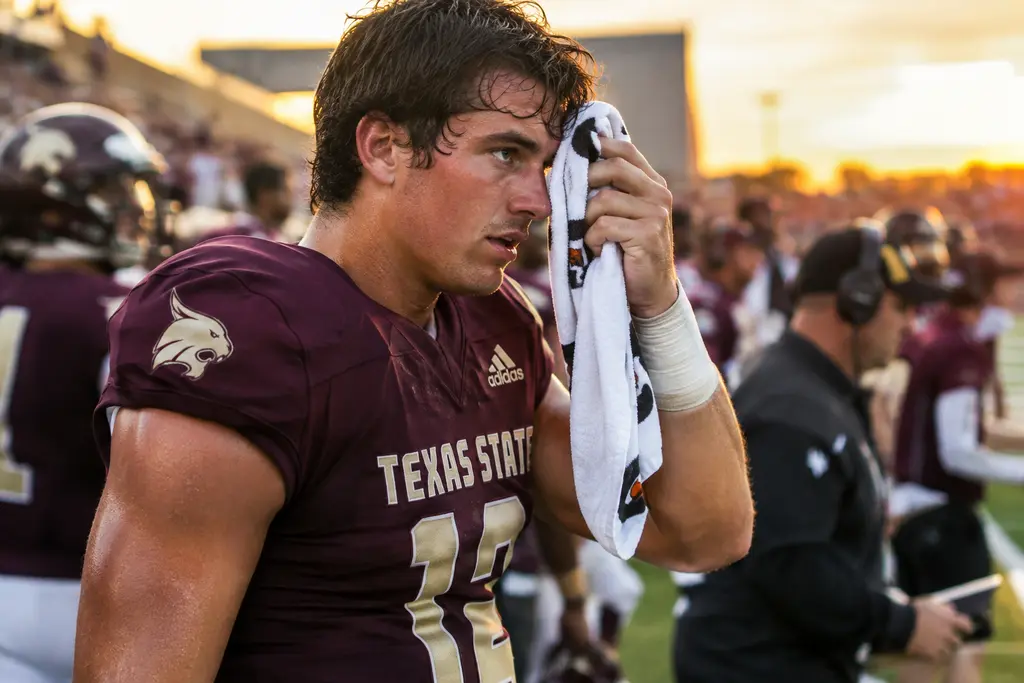

Texas State roster depth has become one of the clearest storylines around the Bobcats’ 2026 football season, especially on offense. Through eight games, the public numbers available as of November 5, 2026, point to a team built around quarterback Brad Jackson, running back Torrance Burgess Jr. and a group of skill players that has given the coaching staff more than one way to move the ball. The evaluation below stays with verified roster and statistical information from Texas State’s official cumulative statistics and Sports Reference’s 2026 roster page.
Evaluating Texas State Roster Depth Through Eight Games
Texas State Roster Depth Starts With Brad Jackson
The first read on Texas State roster depth has to begin at quarterback. Brad Jackson, listed as a redshirt sophomore on the 2026 roster, has carried the offense through both his arm and his legs. Through eight games, Texas State’s official cumulative statistics credited him with 156 completions on 232 attempts for 1,933 passing yards, 18 touchdowns and five interceptions, along with 85 carries for 436 rushing yards and six rushing touchdowns Texas State statistics.
Those numbers show why Jackson is more than a standard pocket distributor. His rushing production gives the Bobcats another backfield threat without removing a running back from the formation. For defensive coordinators, that matters because the quarterback run game can change pursuit angles, third-down spacing and red-zone preparation. For Texas State, it also raises the physical demands placed on the position, making the backup quarterback spot more than a footnote.
Freshman Gavin Parkhurst has appeared in limited action, completing eight of nine passes for 114 yards and one touchdown, according to the Sports Reference 2026 Texas State roster page Sports Reference roster. That small sample does not define how he would handle a larger workload, but it does confirm that the staff has given him game reps. In a season where Jackson has also logged a heavy rushing workload, those reps are worth tracking for roster planning.
The Running Back Room Has A Clear Lead And Useful Support
Torrance Burgess Jr. has been the lead back in the available production profile. Through eight games, Texas State’s official statistics list Burgess with 129 carries for 922 rushing yards, a 7.15 yards-per-carry average and five rushing touchdowns. That combination of volume and efficiency is the kind of foundation that can settle an offense, particularly for a team that also asks its quarterback to create on the ground.
Burgess’ production also affects how the Bobcats can manage tempo. A back producing at that rate helps protect leads, shorten long defensive stretches and keep play-action credible. For the local crowd, that kind of ground game is easy to feel in the stadium: it gives drives rhythm and gives the offensive line a chance to set the tone instead of reacting every snap.
The depth behind Burgess is not empty. Freshman Davian Jackson had 67 carries for 321 yards and five touchdowns through eight games, while senior Jaylen Jenkins had 38 carries for 196 yards and one touchdown. Those numbers do not match Burgess’ lead-back usage, but they show that Texas State has placed real carries in multiple hands. For a November roster review, that is one of the more practical indicators of a backfield with workable options rather than a single-player workload.
Key Skill Players To Watch In The Passing Game
Beau Sparks And Chris Dawn Jr. Give The Offense Experienced Targets
Beau Sparks and Chris Dawn Jr. remain central names in any skill-position conversation, even though the research provided for this review offers more detailed current rushing and quarterback data than full receiver-by-receiver official totals. Sparks entered the discussion with a strong 2025 profile noted in the research: 84 catches for 1,200 yards and 10 touchdowns. That past production helps explain why he continues to be viewed as one of the most significant receivers on the roster.
Dawn’s value is tied to the same broader issue: how much stress Texas State can place on defenses outside the numbers. If Jackson is producing as a passer and runner, and Burgess is forcing defenses to respect inside and perimeter run fits, receiver separation becomes the next pressure point. Sparks and Dawn give the Bobcats experienced options in that part of the offense, while younger or rotational wideouts can benefit from the attention those names draw.
Kylen Evans is one of the depth receivers mentioned in the research, credited with 12 catches for 214 yards through the first eight games. That is not lead-target volume, but it is enough production to matter when evaluating the second layer of the passing game. Receiver depth often shows up in specific moments: a third-and-medium route, a shot play after a turnover, or a snap count increase if a starter needs rest. Evans’ listed production places him in that watch group.
Why Offensive Balance Matters For The Roster
The most useful way to read this offense is not as a collection of separate stat lines. Jackson’s dual-threat output, Burgess’ rushing lead, and the presence of veteran receiver options all connect. If the run game is efficient, passing lanes can open. If the quarterback run remains credible, linebackers can hesitate. If Sparks, Dawn and Evans create enough perimeter stress, defenses cannot pack the box without risk.
That is where Texas State roster depth becomes a football discussion rather than a chart exercise. The top of the roster has produced, but the supporting pieces determine whether the offense can keep functioning through fatigue, opponent adjustments and late-season wear. Bobcat fans have seen enough November football to know that a roster is tested after the first wave of momentum has passed.
How The Backups Shape Late-Season Decisions
Gavin Parkhurst Gives Texas State A Development Marker
Parkhurst’s limited passing line should be read carefully. Eight completions in nine attempts is clean, but the sample is small. The more grounded takeaway is that Texas State has a freshman quarterback who has recorded game action and positive production in that action. For a staff managing both the present season and the next roster cycle, that matters.
Quarterback depth is not only about emergency replacement. It is also about practice structure, redshirt planning, scout-team quality and how confidently the staff can manage late-game situations. If Jackson remains the engine of the offense, Parkhurst’s development still affects how aggressive Texas State can be with quarterback-designed runs and how the staff balances risk across the remaining schedule after November 5.
Davian Jackson And Jaylen Jenkins Keep The Run Game From Becoming One-Dimensional
Davian Jackson’s five rushing touchdowns through eight games stand out because touchdown chances usually require trust near the goal line or in defined packages. For a freshman, that is a meaningful sign even without claiming a larger role than the numbers support. His 321 rushing yards give Texas State a young back with real production behind Burgess.
Jenkins brings a different kind of value as a senior with 196 rushing yards in the available official totals. His workload is smaller, but backs in that range can still shape field position, special-teams depth and late-game ball security. The research also identifies him as a contributor beyond standard rushing work, though the verified statistical discussion here stays with the official rushing line.
For readers following the week-to-week roster picture, our earlier breakdown of Texas State depth chart shifts connects with this same issue: the Bobcats’ best path is not only having stars, but having enough playable options behind them.
What The Numbers Say About Player Development

Production Is Concentrated, But Not Isolated
The production profile is concentrated around Jackson and Burgess, and that is not a negative by itself. Most successful offenses have clear identity players. Texas State’s official numbers show that Jackson and Burgess have carried major responsibility, but the presence of Davian Jackson, Jenkins, Parkhurst and Evans gives the staff additional names to evaluate in real game conditions.
That matters in recruiting and retention. Players want to see a path to snaps. Coaches want to know which players can handle real assignments before conference pressure rises. Supporters want to recognize the names who may become larger parts of the program before they are household names around the Bobcat fan base.
The Research Leaves Defensive Questions Open
The available research for this story is heavily weighted toward offensive skill positions. Because of that, this review should not be read as a full defensive depth assessment. Without verified defensive snap counts, tackle distribution, injury status or position-by-position participation data from high-authority sources in the supplied research, the responsible approach is to keep the focus on the offensive players and backups that can be checked against available records.
That limitation is still useful for readers. It separates what is known from what is assumed. Texas State fans can fairly discuss Jackson’s passing and rushing profile, Burgess’ lead-back production, and the secondary rushing options because those numbers are available. Claims about defensive rotation strength would require a separate source base.
Why Texas State Roster Depth Matters In San Marcos
Texas State roster depth is not just a staff-room topic. It is tied to how the Bobcats sustain energy through November, how the offense protects its most-used players and how the program keeps local supporters invested beyond the headline names. Jackson and Burgess have earned the attention, but the season’s shape can also be influenced by Parkhurst’s readiness, Davian Jackson’s growth, Jenkins’ reliability and the receiver group’s ability to stretch defensive attention.
For a community that follows roster movement closely, the most encouraging part is that the Bobcats have more than one contributor with verifiable production. The next step is not making unsupported claims about what the depth chart will become. It is watching how the staff continues to distribute touches, how backups respond to bigger moments, and whether the offense can keep its balance as the schedule tightens after November 5, 2026.