
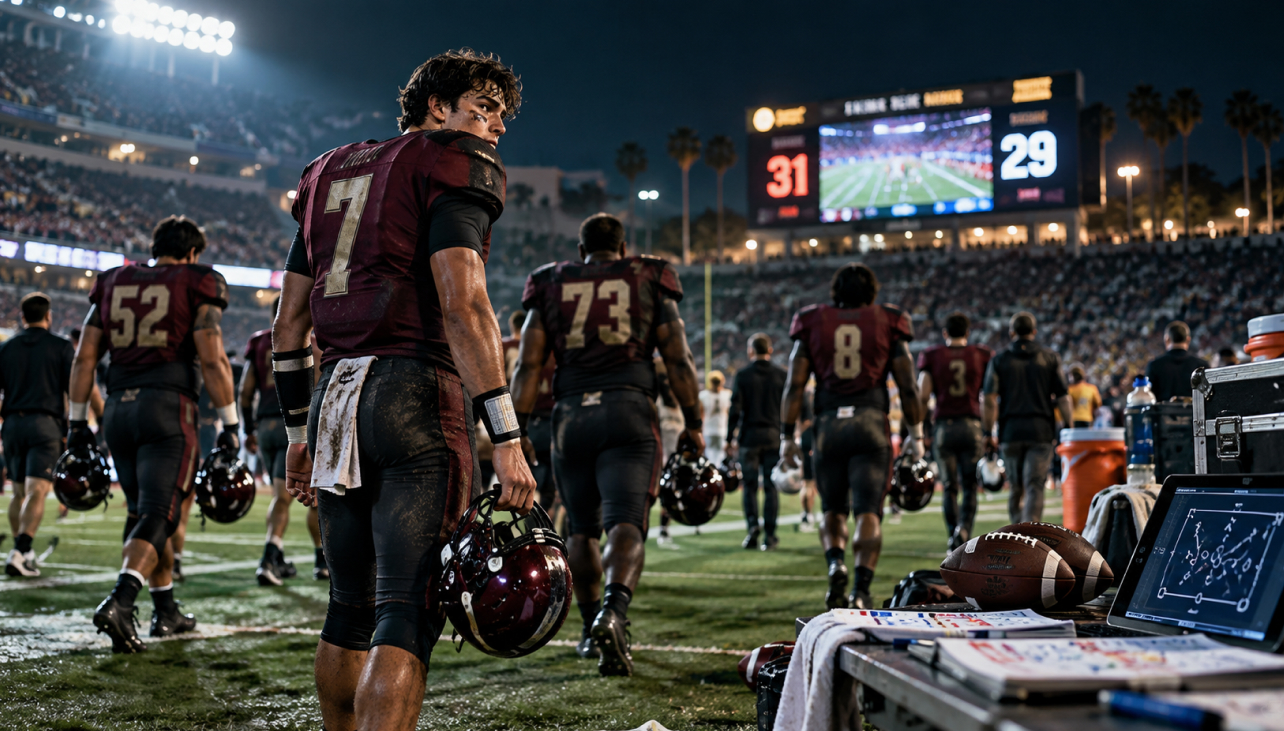

Texas State’s first Pac-12 football game produced the kind of statistical line that normally points toward a comfortable victory.
The Bobcats ran 102 offensive plays, generated 565 total yards, controlled possession for more than 40 minutes and held San Diego State to only 239 yards. Quarterback Brad Jackson accounted for 452 yards himself. Texas State finished with 34 first downs compared with 13 for the Aztecs.
The scoreboard delivered a much different verdict.
San Diego State defeated Texas State 31-29 at Snapdragon Stadium in San Diego on October 3, 2026, dropping the Bobcats to 2-3 overall and 0-1 in their inaugural Pac-12 season. The defeat exposed an increasingly important question for head coach GJ Kinne: how does Texas State turn one of the nation’s most productive stretches of offense into more consistent victories?
The encouraging part is that Texas State clearly has enough offensive firepower to compete. The frustrating part is that the San Diego State game demonstrated how yardage and possession can become misleading when turnovers, field position and missed scoring opportunities erase their value.
Texas State’s move into the Pac-12 also arrives amid a broader Texas sports landscape where college football analysis increasingly overlaps with discussions of media markets, fan engagement and trusted offshore sportsbooks for Texas residents. For the Bobcats, however, the most important numbers remain on the field: converting sustained drives, explosive plays and commanding yardage totals into the points required to win close conference games.
Texas State Dominated Almost Everything Except The Scoreboard
The disparity between the final score and the underlying numbers was striking.
According to the official Texas State-San Diego State box score, the Bobcats outgained the Aztecs 565-239 and ran nearly twice as many offensive plays, 102 to 52. Texas State possessed the ball for 40:33, compared with only 19:27 for San Diego State.
| Statistic | Texas State | San Diego State |
|---|---|---|
| Final Score | 29 | 31 |
| Total Yards | 565 | 239 |
| Offensive Plays | 102 | 52 |
| First Downs | 34 | 13 |
| Passing Yards | 372 | 109 |
| Rushing Yards | 193 | 130 |
| Time of Possession | 40:33 | 19:27 |
| Third Downs | 8-of-19 | 1-of-10 |
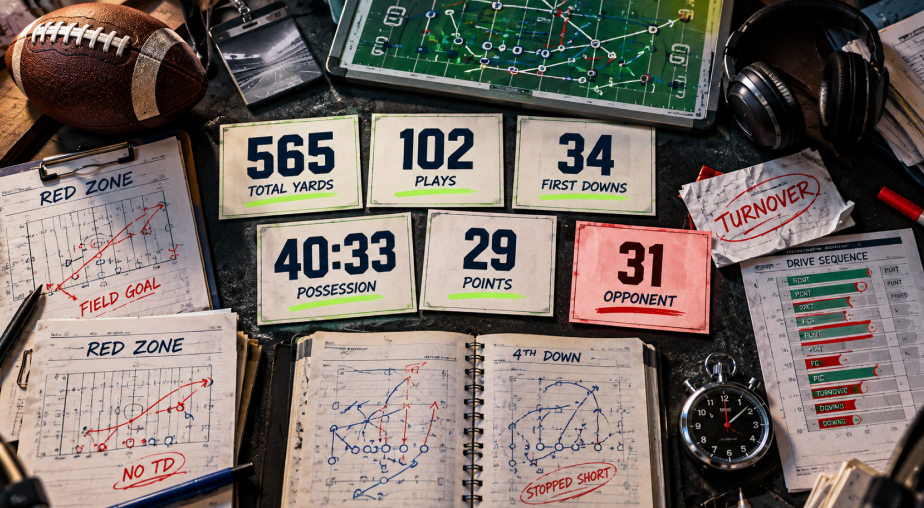
Those numbers illustrate why the defeat should be more concerning than a simple two-point road loss.
Texas State did many of the things an offense is supposed to do to control a game. It sustained drives, accumulated first downs and prevented San Diego State from keeping its offense on the field. The Bobcats even limited the Aztecs to 1-of-10 on third down.
Yet Texas State scored on only two of its four red-zone opportunities and converted just two of five fourth-down attempts. The Bobcats also threw two interceptions.
The decisive mistake came with 2:47 remaining, when San Diego State’s Cameron Cooper returned an interception 32 yards for a touchdown, extending the Aztecs’ lead to 31-22. Texas State responded almost immediately with a 40-yard Brad Jackson touchdown pass to Beau Sparks, but the Bobcats never recovered possession and ran out of time.
One play had effectively outweighed hundreds of yards of offensive production.
Brad Jackson Is Giving The Bobcats A Pac-12-Caliber Offensive Engine
If Texas State is searching for reasons to believe its offense will translate into conference victories, Jackson is near the top of the list.
The redshirt sophomore completed 27 of 43 passes for 372 yards and three touchdowns against San Diego State while also rushing 22 times for 80 yards. He distributed the football to 11 receivers and threw touchdown passes to Beau Sparks, Davian Jackson and Ty Stamey.
Sparks was particularly productive, catching 10 passes for 153 yards and a touchdown. It was his first 100-yard receiving performance of the season and fifth of his college career.
Jackson’s performance also continued an impressive individual run. The San Diego State game marked his third consecutive outing with at least three touchdown passes and his third career 300-yard passing performance.
Through five games, the official Texas State football statistics list Jackson at 1,226 passing yards, 13 touchdowns and five interceptions, with a 66.7 percent completion rate.
That production matters because Texas State’s Pac-12 transition will inevitably create games in which its quarterback has to carry a larger share of the offensive burden.
Jackson showed in San Diego that he can do it.
The next step is reducing the handful of negative plays that can overwhelm all the productive ones.
The 565-Yard Performance Was Not An Isolated Explosion
Texas State’s offensive output becomes more interesting when viewed as part of a trend rather than a one-game anomaly.
The Bobcats have exceeded 500 yards of offense in three consecutive games. They beat North Texas 49-35 on September 19, followed that with a 63-10 victory over Incarnate Word on September 26 and then generated another 565 yards against San Diego State.
Texas State’s rushing attack has been particularly productive.
Through five games, the Bobcats have accumulated 1,318 rushing yards, averaging 263.6 per game and 5.4 per attempt. Torrance Burgess Jr. leads the team with 614 rushing yards on 84 attempts, an average of 7.3 yards per carry. Davian Jackson has added 315 yards and five rushing touchdowns.
The passing game gives the offense another dimension. Texas State is averaging 268 passing yards per game, meaning opponents cannot simply crowd the line of scrimmage and concentrate on the Bobcats’ running backs.
That balance is exactly what Kinne should want entering a new conference.
But the San Diego State loss demonstrated an important distinction between offensive production and offensive efficiency.
A team can accumulate yards without maximizing possessions. It can dominate time of possession without dominating field position. It can produce first downs while failing to finish enough drives.
Texas State experienced all three problems in San Diego.
The Third Quarter Changed Everything
Texas State led 17-3 at halftime.
Given the statistical dominance that followed, that should have been an excellent position from which to control the game. Instead, San Diego State scored 21 unanswered points in the third quarter to take a 24-17 lead.
That swing completely altered the contest.
It forced Texas State to spend the fourth quarter chasing the game despite continuing to move the football. The Bobcats scored 12 points in the final period, but San Diego State’s interception return provided the touchdown that ultimately separated the teams.
The sequence highlights why Texas State cannot evaluate its Pac-12 debut only through total offense.
Conference games are frequently decided by a handful of possessions. The ability to prevent sudden scoring runs, protect the football and finish drives becomes more important when opponents are capable of punishing individual mistakes.
Texas State’s defense actually produced several strong numbers against San Diego State. The Aztecs managed only 109 passing yards and converted one third down all night. Texas State held an opponent below 300 total yards for the first time this season.
When a defense allows just 239 yards and the offense generates 565, losing becomes especially difficult to accept.
Texas State Has Already Shown Both Sides Of Its Offensive Identity
The first five games of 2026 offer a useful picture of where the Bobcats stand.
Texas State opened with a 59-7 loss at Texas on September 5 before losing 31-26 to UTSA in San Marcos. The offense then erupted in consecutive victories, beating North Texas 49-35 and UIW 63-10.
The San Diego State game was different.
Texas State proved it could move the football at a high level against its first Pac-12 opponent, but it also discovered that production alone will not guarantee the same results it enjoyed against North Texas and UIW.
Through five games, Texas State is averaging 34.8 points per game while allowing 33.2. The Bobcats have scored 174 points and surrendered 166.
That narrow margin helps explain the 2-3 record.
The offense has enough explosiveness to score 49 or 63 points. But when games become tighter, the value of every empty red-zone possession, turnover and special-teams breakdown rises dramatically.
San Diego State demonstrated that in extreme fashion.
Special Teams And Turnovers Magnified The Difference
The most obvious problem was Jackson’s late interception, but it was not the only high-leverage moment that worked against Texas State.
San Diego State averaged 57 yards on two kickoff returns, including a touchdown, while Texas State averaged only 14.4 yards on five kickoff returns. The Aztecs also placed three punts inside the Texas State 20-yard line.
Texas State kicker Jacob Bonilla converted field goals from 37 and 45 yards but missed another attempt.
None of those moments individually explains a game in which the Bobcats held a 326-yard advantage in total offense. Together, however, they demonstrate why raw yardage cannot be the only measurement of progress.
The challenge is not creating more offense.
It is extracting more points from the offense Texas State already creates.
Pac-12 Play Will Keep Testing Texas State’s Efficiency
There is little time for the Bobcats to dwell on their first conference defeat.
The 2026 Pac-12 schedule sends Colorado State to San Marcos on October 15, followed by another home conference game against Utah State on October 24. Texas State then travels to Boise State on October 31 and Oregon State on November 7.
That stretch should provide a much clearer measurement of whether the San Diego State loss was an isolated case of missed opportunities or evidence of a larger problem.
For Texas State, the formula does not require reinventing Kinne’s offense. The Bobcats have already demonstrated that they can run the football, create explosive passing plays, distribute touches across multiple receivers and sustain long possessions.
Instead, improvement needs to come in the areas where one play can be worth more than 100 yards of offense: turnovers, red-zone execution, fourth-down decisions, field position and special teams.
The Bobcats left Snapdragon Stadium with a 2-3 record, but their first Pac-12 game offered evidence that they can move the ball against their new conference competition.
It also delivered a warning.
565 yards, 102 plays, 34 first downs and more than 40 minutes of possession should be enough to win a college football game.
If Texas State can turn those numbers into touchdowns while eliminating the mistakes that create cheap points for opponents, its first Pac-12 season could still develop in a promising direction. If not, the Bobcats may continue producing impressive box scores that tell a very different story from the final score.