
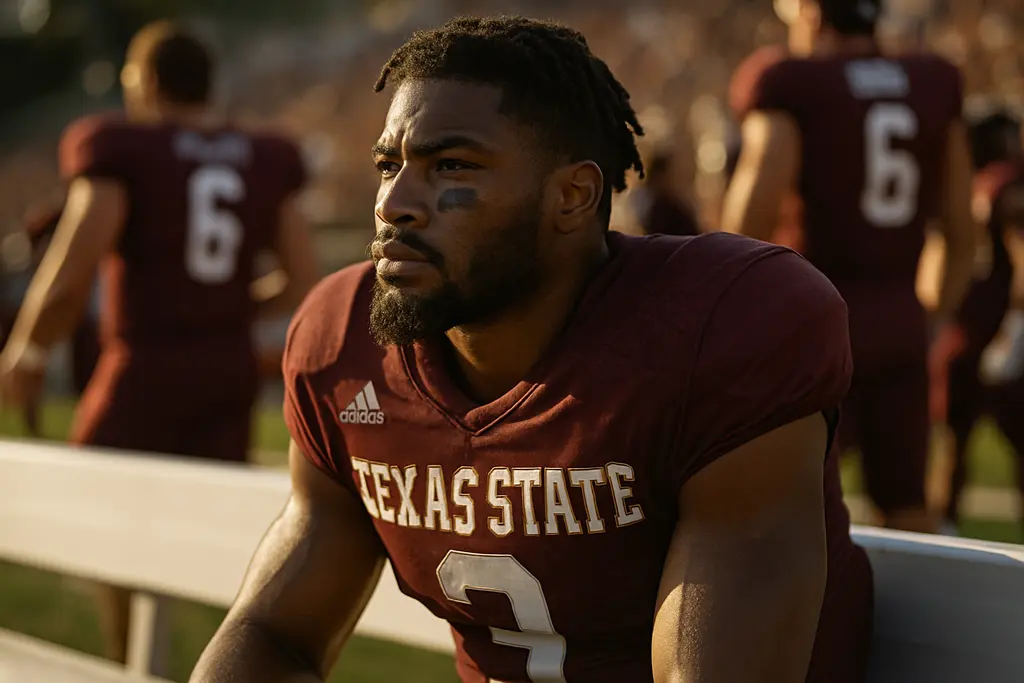

Texas State depth was the story beneath the headline when the Bobcats opened their Pac-12-era schedule at Texas on September 5, 2026. That game has already been played as of October 8, 2026, so the sharper question now is not what might happen in Austin, but what the roster structure revealed about how G.J. Kinne’s program entered a larger competitive stage. The Pac-12 schedule listed Texas State at Texas for September 5, giving San Marcos an immediate high-profile road assignment to begin the new chapter.
What Texas State Depth Showed Before Austin
Texas State Depth At Quarterback Started With Brad Jackson
The cleanest roster signal came at quarterback. Public depth data after the opening stretch showed Brad Jackson, a redshirt sophomore, as the primary option, with freshman Gavin Parkhurst behind him and Shaker Reisig, Stone Walker and Easton Webb listed as further depth. The Texas State depth chart listed Jackson with roughly 87 percent of quarterback snaps through the first four games and Parkhurst with about 13 percent.
That split matters because early Pac-12-era pressure did not leave Texas State guessing at the most visible position on the field. A clear starter gives the offense a shared rhythm in practice, helps receivers understand timing and gives the offensive line a consistent cadence to protect. Parkhurst’s role also carried value. A freshman backup who is not buried from the rotation can take meaningful developmental snaps without the staff handing him the full weight of the offense.
For a San Marcos program trying to turn conference realignment into on-field credibility, the quarterback room showed both order and a future plan. Jackson’s snap share pointed to trust. Parkhurst’s involvement showed the staff still had an eye on continuity beyond one opener.
The Running Back Rotation Was Not A One-Back Plan
The running back room had a different shape. Torrance Burgess Jr. led the group in the early data at about 44 percent of snaps, while freshman Davian Jackson followed at roughly 36 percent. Jaylen Jenkins and Juntavious Harris also appeared in the rotation, giving the Bobcats a four-player group rather than a single-feature back structure.
That distribution carries a local football value beyond the stat sheet. Texas State has built much of its recent identity around tempo and offensive volume. A multi-back rotation helps protect that identity because it allows the staff to manage contact, use different body types and keep a young player such as Davian Jackson involved without forcing him into every protection call or short-yardage snap.
Burgess still gave the room a veteran lead, which matters in road environments. A senior back can steady the offense in pass protection and down-and-distance decisions. Davian Jackson’s snap share, though, suggested the Bobcats were not treating youth as a reason to wait. That is one of the clearest roster development signs from the first month.
Receiver Usage Pointed To Star Power And Competition
Chris Dawn Jr. And Beau Sparks Set The Top Line
The wide receiver room had a more defined top than the backfield. Chris Dawn Jr. was listed with about 76 percent of receiver snaps, while Beau Sparks followed at roughly 43 percent. Those numbers reflected two trusted options at the front of the formation, with Dawn carrying the heaviest workload.
That type of top-end receiver clarity helps a quarterback on the road. Jackson could enter the opener knowing which targets were likely to stay on the field in high-leverage downs. For a program representing San Marcos in a new conference setting, that matters because offensive continuity is often what keeps an underdog road game from getting away early.
Sparks’ role also gave the offense another route through coverage. A second receiver with heavy usage prevents the passing game from becoming too dependent on one player. The Bobcats did not need every receiver role solved before the Texas trip, but they did need enough proven volume to keep the offense from shrinking.
The WR3 Race Created A Real Development Window
The third receiver picture was less settled. Tucker Cusano, Zechariah Sample and Kylen Evans were listed in the mix based on recent usage, with Cusano appearing ahead among that group in the early snap data. That competition is one of the more useful places to study roster growth because it sits between present-day production and future planning.
Receiver depth is not just about catching passes. It affects special teams options, practice tempo, red-zone packages and injury protection. A player who becomes the third trusted receiver can change how often Texas State spreads the field, how it attacks nickel personnel and how it keeps Dawn and Sparks fresh during longer possessions.
For a program moving into a wider Pac-12 travel map, that third receiver role also had week-to-week importance. Road trips, changing kickoff windows and stronger opponent depth can expose thin position groups. The early data showed Texas State had a real competition there, not an empty slot.
Where The Roster Still Needed Answers
Depth Beyond The Ball-Handlers Was Harder To Measure Publicly
Public snap-based data gave the clearest picture at quarterback, running back and receiver. It did not answer every question across the roster. That distinction matters. Offensive line rotation, tight end usage, defensive back health and special teams confidence can shape a game as much as the top skill players, but not every part of that picture was verified in the same way from the allowed public sources.
That does not make those areas less meaningful. It simply means the supported read should be careful. Texas State entered the opener with visible offensive structure around Jackson, Burgess, Davian Jackson, Dawn and Sparks. The less public parts of the roster remained areas where performance in September had to provide the evidence.
For readers tracking the roster across the season, our earlier San Marcos-focused roster work on Texas State depth chart changes fits with the same core idea: realignment raises the cost of thin spots. It does not allow a program to hide behind one productive position group.
Why The Opener Was A Roster Stress Test
The Texas game was more than a brand-name opener. It was a stress test for how the Bobcats distributed responsibility. A roster with one high-volume quarterback, two clear top receivers and a shared running back room can look balanced on paper. The field asks harder questions: Can the backup quarterback be ready if needed? Can the young back handle pass protection? Can the third receiver win enough snaps to keep coverage honest?
Those questions mattered to the San Marcos community because Texas State’s Pac-12 move was not only a schedule change. It changed the type of scrutiny around every Saturday. Families, students, alumni and local businesses saw the Bobcats carry the city into a bigger football conversation. Roster depth became part of that civic sports identity because it showed whether the program had enough players ready for the stage.
Why Texas State Depth Still Frames San Marcos
Texas State depth was not a one-week talking point after the September 5 trip to Austin. It remains the clearest way to judge how sustainable the Bobcats’ Pac-12-era build can be. A stable quarterback room helped set the foundation. A shared backfield gave the offense multiple paths. A receiver group led by Dawn and Sparks offered high-usage targets, while the WR3 battle created room for a younger player to earn trust.
The supported public data does not prove that every position was settled. It does show that the offense had a recognizable structure before the first major test. That matters because roster depth is not just a coach’s chart; it is the working plan for how a team survives travel, pressure, substitutions and injuries across a longer campaign.
That is why Texas State depth still frames the local story in San Marcos. The Bobcats’ move into a new conference raised expectations, but the path forward remains player by player and position by position. The opener at Texas gave the program an early mirror. The first month gave us a better view of who the staff trusted. The rest of the season will keep measuring whether that trust was deep enough.