


Texas State Risers became the central camp story because the Bobcats were not simply sorting names on a depth chart before the 2026 schedule began. They were weighing proven production against new competition, spring showcase flashes and the kind of roster depth needed for a larger stage. The public record from spring and preseason reporting is stronger than the closed-fall-camp record, so the fairest read is this: Texas State entered September with established stars at receiver and quarterback, while the offensive line, running back room and secondary carried the most meaningful development questions.
That distinction matters in San Marcos. A player can be a camp riser without being a surprise starter. Sometimes the rise is about taking a bigger leadership share. Sometimes it is a freshman forcing coaches to keep him in the conversation. Sometimes it is a veteran returning from a quiet year and giving a position group a steadier floor. Texas State had examples across those categories.
Texas State Risers Start With Proven Receivers
The most obvious place to begin is wide receiver, where Texas State did not need camp hype to identify its top-end talent. Beau Sparks entered his senior season after setting a school record in 2025 with 84 receptions for 1,200 yards and 10 touchdowns, according to his official Texas State roster. Those numbers are not camp projection. They are production, and production changes the way every practice rep is judged.
Beau Sparks Raised The Standard
Sparks’ rise is different from a young player suddenly getting noticed. His development question was not whether he belonged near the top of the receiver rotation. It was whether he could carry the day-to-day standard of a veteran target while defenses and teammates understood he had already put elite program numbers on tape.
For Texas State, that kind of receiver matters beyond the stat sheet. A wideout who can win outside, finish catches and handle attention gives the quarterback a reliable answer when a practice period turns chaotic. It also gives younger receivers a visible model for route tempo, spacing and competitive consistency. In a local program trying to turn recent progress into staying power, that example carries weight.
How Texas State Risers Create Room For Others
Chris Dawn Jr. gave the room another high-end returning piece after a 2025 season credited in the research with 65 catches, 1,007 yards and four touchdowns. Pairing that kind of production with Sparks meant the receiver room did not enter camp as a one-man operation. The sharper question was how the offense would use attention on those veterans to create cleaner opportunities elsewhere.
For Texas State Risers, the receiving group shows why camp development is not always about a new name passing an old one. It can be about a proven player sharpening timing with the quarterback, pushing the back end of the depth chart and forcing the defense to solve harder practice problems. That is useful growth even before the first public depth chart answers every question.
Quarterback And Backfield Competition Set The Tone
Quarterback stability shaped the rest of the offense. Brad Jackson’s 2025 season, when he threw for 3,224 yards and 21 touchdowns, supplied the statistical backdrop for the spring and camp conversation, as noted in the Yahoo Sports spring showcase report. A returning quarterback with that production changes the practice floor. Receivers can be evaluated through timing rather than guesswork, linemen get a clearer cadence, and backs are judged in an offense that already has a defined passing identity.
Brad Jackson Made Camp Evaluation Cleaner
Jackson’s value in camp was not only tied to throws down the field. Returning quarterbacks speed up evaluation because coaches can see whether other players are fitting into the system. If a route breaks late, if a protection call is missed or if a back fails to hit the designed crease, the staff has a steadier reference point. That does not make the offense finished, but it gives every position group a more honest measuring stick.
The research also identified Shaker Reisig, a redshirt freshman transfer from Boston College, as the No. 2 quarterback behind Jackson. His prior college record listed three games in 2025, with 10 completions on 19 attempts for 141 yards. That is a small sample, so any judgment should stay modest. His camp value was more about establishing backup readiness than challenging the identity of the offense.
Running Back Work Became A True Audition
The backfield carried a different tone. After Greg Burrell’s spring dismissal, the competition widened. Taji Atkins and transfer Davian Jackson were both credited in the spring showcase reporting with explosive runs of more than 25 yards. That kind of note does not settle a rotation, but it does identify the trait coaches needed to see: burst that can punish a defense already stretched by Texas State’s passing game.
For a San Marcos crowd used to seeing the Bobcats score through space, the running back answer mattered. A productive run game keeps the offense from leaning too heavily on Sparks, Dawn and Jackson. It also helps the line build confidence through physical series rather than pass-protection stress on every possession. Camp did not need to crown one back publicly to be productive. It needed to show that the room had more than one candidate capable of creating explosive gains.
Line And Secondary Depth Changed The Camp Math
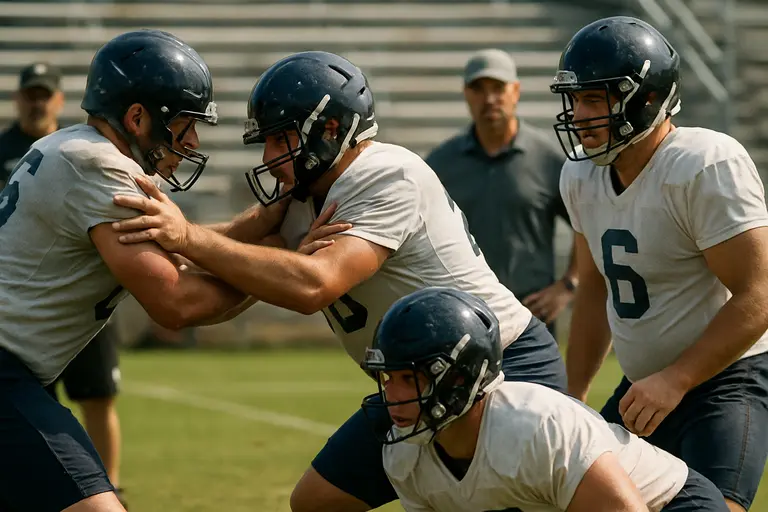
Offensive line development rarely draws the same attention as receiver records or quarterback totals, but it may have been one of the better camp signals for Texas State. The spring showcase reporting pointed to freshmen Eric Perkins at left tackle and Preston Ward, along with veteran Etueni Ropati, as linemen who made strong impressions. Those are not minor notes for a program trying to strengthen its week-to-week roster base.
Young Linemen Offered Early Clues
Freshmen linemen who get mentioned during spring work are not guaranteed September starters. The jump from promising practice reps to full-game reliability is large, especially up front. Still, Perkins and Ward appearing in the conversation mattered because tackle and interior depth can swing a season when injuries, travel and fatigue arrive.
Ropati’s presence gave the line a different type of value. Veteran competition can steady a room while younger players develop. If the younger linemen pushed the tempo and Ropati helped hold the standard, Texas State came out of camp with better internal pressure than a thin two-deep can provide. That is the kind of roster growth that connects directly with Texas State roster depth questions as the program measures itself against tougher weekly demands.
Secondary Competition Had A Different Feel
The defensive back group carried more uncertainty in the public record, but the names in the research show why the position was a camp focal point. Ryan Nolan returned as the most established safety reference after a 2025 season credited with 79 tackles and 3.0 tackles for loss. Around him, younger players such as Jayden Bradley and Cordarian Powell were identified as developmental names, while Jayden Lawton, Trez Moore, Dexter Ricks Jr. and Michael Patterson III added competition or experience to the cornerback picture.
That group should be read carefully. Public notes from spring and preseason work do not equal a final fall depth chart. Still, the broad direction was clear: Texas State needed more playable defensive backs, and camp gave the staff a chance to sort which players could handle coverage rules, tackling space and communication demands. In a pass-heavy college game, secondary depth is not a luxury. It is survival over four quarters.
Why Texas State Risers Matter In San Marcos
The local meaning of these developments is straightforward. Texas State’s best camp signs came where strong programs usually need them: proven stars still setting the pace, a returning quarterback stabilizing the offense, young linemen pressing for attention, and a secondary building more options. None of that guarantees results, and the public information available after camp does not support sweeping claims about every position battle. It does, though, show where the Bobcats had real growth points before the 2026 schedule began.
Texas State Risers are not just names for preseason conversation. They are the players who shape how a community sees the team between Saturdays. Sparks gives San Marcos a record-setting receiver to rally around. Jackson gives the offense a known center. Atkins, Davian Jackson, Perkins and Ward give fans new development tracks to follow. Nolan and the defensive backs give the defense a set of questions that could define tight games.
The best player-development story is rarely limited to one breakout. For Texas State, the camp picture was more layered: established leaders at the top, contested depth behind them and enough young movement to make the roster feel less fixed than it did in spring. That is why these camp notes mattered. They showed a program trying to turn individual growth into team reliability, with San Marcos watching closely as promise moved from practice fields into game weeks.