
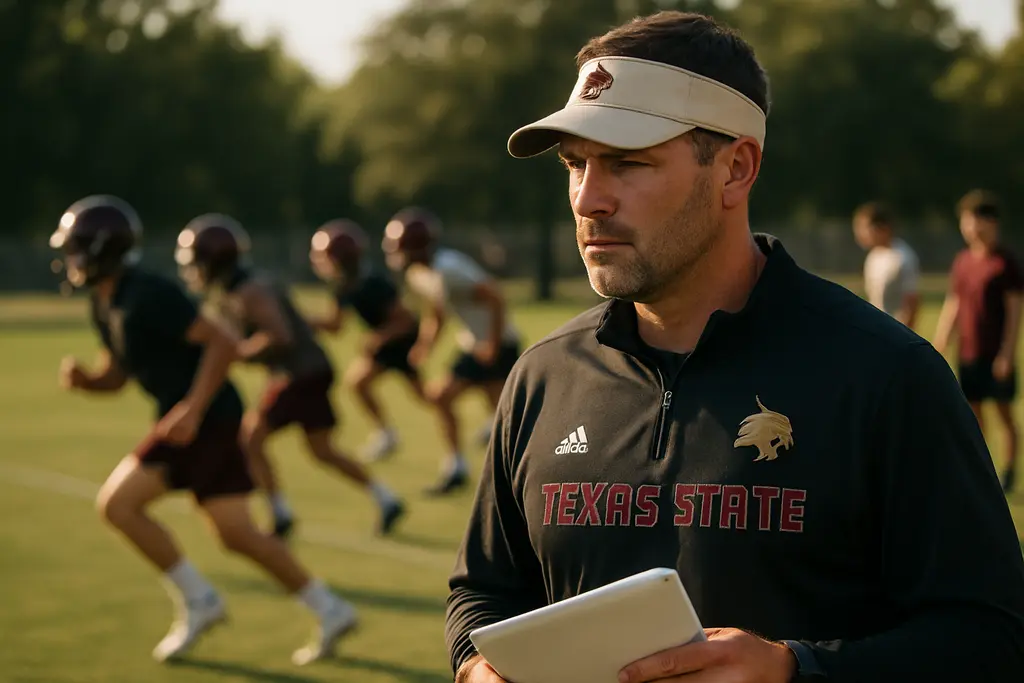

Texas State recruiting has reached a different stage in 2026: the Bobcats are not simply filling a class, they are trying to build a roster that fits a tougher conference setting while keeping a strong Texas identity. The available recruiting data shows a class with clear local ties, a few high-interest names, and positional needs that matter for San Marcos as much as they matter on a depth chart.
Texas State Recruiting Class Snapshot
Where The 2026 Class Stands
On3’s Industry comparison lists Texas State’s 2026 football class at No. 73 nationally with a class score of 85.09, 22 commits and no 5-star recruits, while also showing that roughly 68 percent of the group came from Texas high schools On3 commit rankings. That is the cleanest starting point for evaluating the class. It is not a national top-25 haul, but it does show a program that has built a full class and kept most of its additions close to home.
Punt & Rally’s recruiting page gives another view of the same group, with the top 13 rated Texas State recruits averaging about 85.4 in its listed ratings Punt & Rally class data. For a program adjusting to a new competitive tier, that average matters because it points toward a class built more on volume, fit and development than on a handful of national headline recruits.
Why Texas State Recruiting Starts In Texas
The in-state share is the defining feature of the class. A Texas-heavy group gives the Bobcats a practical foundation: shorter family travel to San Marcos, stronger high school coach relationships, and more familiarity with the athletic profile across the state. Texas State does not have to win every major recruiting fight in the state to benefit from that approach. It needs to identify players who fit its scheme, develop them quickly, and keep enough of them in the program long enough to create real roster stability.
That makes Texas State recruiting a community story as well as a football story. When nearly seven out of every 10 commits are in-state prospects, the class connects the Bobcats to Friday night programs across Texas. For fans in San Marcos, Kyle, New Braunfels, Austin, San Antonio and the surrounding areas, the roster becomes easier to follow because more players arrive with local or regional ties.
Critical Positions In The 2026 Class
Wide Receiver Depth Fits The Offensive Identity
The research points to wide receiver as one of the stronger areas by numbers, with roughly four to five recruits in the class. That aligns with the offensive direction under head coach G.J. Kinne, whose system has asked receivers to win in space and react quickly after the snap. The presence of returning production at receiver in the broader roster picture gives the incoming players time to grow rather than forcing every freshman into an immediate role.
For a class like this, receiver recruiting is not just about counting bodies. The Bobcats need different profiles: slot quickness, outside size, return ability and players who can handle motion-heavy assignments. A deep receiver group gives the staff more options in practice, on special teams and in future rotation battles. It also protects the program from the natural churn that comes with modern college football roster movement.
The Line Of Scrimmage Remains The Key Question
Offensive line is the position group that deserves the most careful read. The research describes the final alignment as unsettled, with returning tackle Sully Burns likely to start and other tackle and interior roles still being sorted. That type of uncertainty is common, but it carries more weight for Texas State because conference play in 2026 raises the weekly physical standard.
The class appears to include two to three offensive line recruits, which gives the staff developmental pieces but does not answer every short-term question. Offensive linemen often need time: strength work, footwork, calls, communication and comfort against college defensive fronts. The real value of this group may not show up immediately on a Saturday depth chart. It may show up in 2027 or 2028 if the Bobcats can develop multi-year starters from this class.
Defensive line also stands out. The class includes several front-seven additions, and Jussiah Ali, listed as a defensive tackle from Trinity Valley Community College with San Antonio ties, gives the Bobcats a junior-college option with interior size. His listed 6-foot-2, 300-pound frame matters because interior defensive line depth is difficult to find and hard to fake. Texas State needs bodies there who can hold ground, rotate without a major drop-off and keep linebackers cleaner at the second level.
Players Who Could Shape The Class
La’Keyleon Graves Brings The Headline Profile
La’Keyleon Graves is the name that naturally draws attention. The research identifies the Kilgore athlete as Texas State’s first 4-star high school recruit and lists September 12, 2025, as his signing date. That label alone does not guarantee immediate production, but it does change the conversation around the class. A player with that profile gives the staff a high-upside piece who can be evaluated across offense, special teams and matchup-based packages.
The most valuable part of Graves’ profile may be flexibility. An athlete designation can mean different things from one recruiting service to another, but for Texas State it suggests a player whose role does not have to be locked in too early. If he is ready physically and mentally, he could push for package work. If development takes time, the staff can still shape his position based on roster need.
Jussiah Ali Adds Needed Interior Weight
Ali’s case is different. He is not the same type of long-range projection as a high school skill player. As a junior-college defensive tackle, his value is tied to readiness. Texas State’s defensive front needs players who can handle early-down contact, absorb double teams and keep the rotation fresh across a full schedule.
That does not mean Ali should be treated as a guaranteed starter. It means his position gives him one of the clearer paths to mattering early if he adjusts well. In roster construction, interior defensive linemen are often less visible to casual fans than quarterbacks and receivers, but they can shape the entire defensive structure. If Texas State becomes sturdier inside, the rest of the defense has a better chance to play on schedule.
How The Class Fits Roster Development

Balance Between High School, JUCO And Portal Needs
The 2026 class reflects a program trying to reduce pure transfer dependency without ignoring immediate needs. Kinne’s staff has used the portal heavily in prior roster building, but the research indicates the goal is a better balance between high school signees, junior-college help and transfers at high-need positions. That approach is sensible for a team trying to stay competitive right away while also building a base that can last multiple seasons.
For readers tracking the broader roster plan, our related 2026 class outlook fits with the same theme: the Bobcats need short-term answers, but they also need a pipeline that keeps the roster from resetting every winter.
- Wide receiver numbers support the offensive structure and create special teams options.
- Offensive line recruiting gives the staff developmental pieces, but the starting combination remains a key issue.
- Defensive line additions, especially inside, could influence how quickly the defense adjusts to stronger weekly competition.
- The Texas-heavy makeup strengthens local ties and keeps the Bobcats visible in key high school programs.
Why Development Will Decide The Class Grade
Recruiting rankings are useful, but Texas State’s real grade will come from player development. A No. 73 national class can become more valuable if the staff turns multiple 3-star prospects into starters, keeps local players invested, and finds early snaps for the most physically ready additions. It can also stall if the offensive line remains unsettled or if the defensive front lacks playable depth.
That is why the class should be judged by role creation, not just by stars. Can the receivers handle the tempo and spacing demands? Can the offensive line recruits grow into conference-level bodies? Can Ali or another defensive front addition help right away? Can Graves become a weekly matchup piece rather than a recruiting headline? Those are the questions that will define this group in San Marcos.
What Texas State Recruiting Means For San Marcos
Texas State recruiting in 2026 tells a clear local story. The Bobcats have built a class ranked in the national middle tier, but its value sits in the details: Texas roots, receiver volume, defensive tackle help, offensive line development and one major headliner in Graves. That is a practical blueprint for a program trying to raise its level without losing the regional identity that gives it traction.
For San Marcos, the class also gives fans a reason to track more than the transfer portal. Local and in-state signees can become multi-year faces of the program. Families can travel to UFCU Stadium with real ties to the roster. High school coaches across Texas can point to a clearer pathway into the Bobcats’ program.
The most honest view is neither hype nor doubt. Texas State has not signed a class full of national top-100 prospects, and the offensive line still carries questions. Yet the class has enough balance to matter if the staff develops it well. The 2026 group gives the Bobcats a chance to build depth the slower way, through evaluation, retention and local trust. For Texas State recruiting, that may be the piece that matters most as the program tries to turn a Texas-heavy class into a Pac-12-ready roster.