
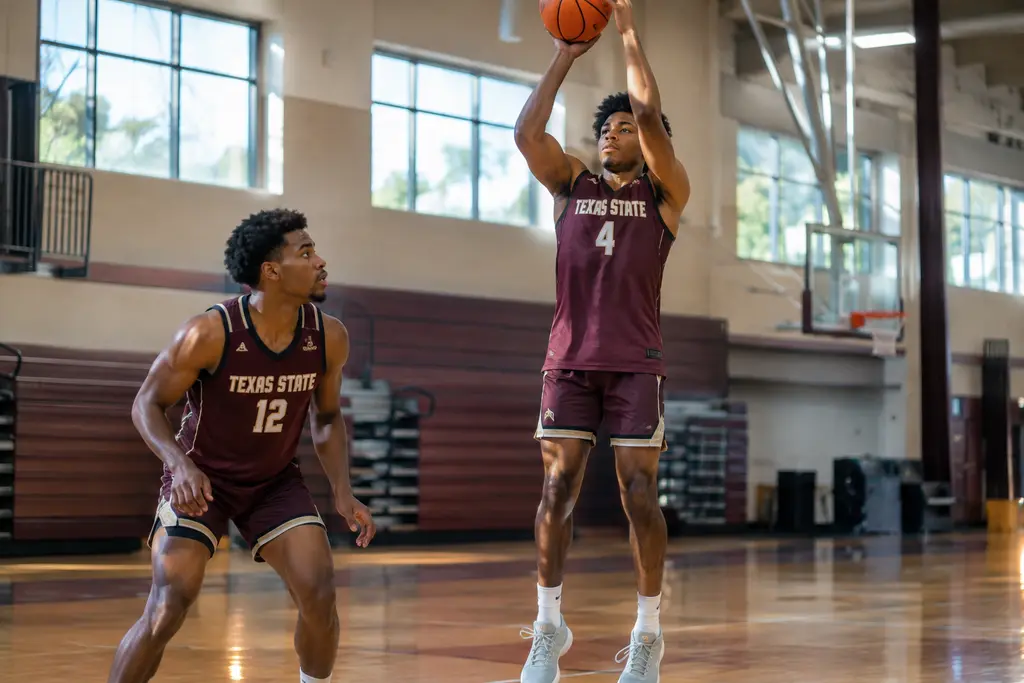

Texas State Freshmen are not a side story for the men’s basketball program anymore. They have become part of the roster’s identity in San Marcos, starting with D.J. Hall’s production during the 2025–26 season and extending into a 2026 recruiting class built across the frontcourt, wing and point guard spots. For a Bobcats program moving from the Sun Belt into a Pac-12 setting for the 2026–27 season, that youth movement matters because it gives the staff more than short-term depth. It gives Texas State a player-development thread that local supporters can track from first college minutes to larger conference tests.
How Texas State Freshmen Changed The Frontcourt
Texas State Freshmen Started With Hall’s Breakthrough
D.J. Hall gave Texas State a clear freshman headline in 2025–26. The Plano East forward averaged 15.6 points, 7.7 rebounds, 2.3 assists and 1.4 steals across 32 games, while shooting about 54.1 percent from the field. On March 2, 2026, he was named Sun Belt Freshman of the Year and earned All-Sun Belt Second Team honors, according to Yahoo Sports. Those numbers explain why his first season changed the way the roster could be discussed. Hall was not only a young player getting experience. He became a featured frontcourt piece with scoring, rebounding and enough passing activity to affect how the Bobcats could run offense through the interior.
For San Marcos, Hall’s rise also carried a local sports angle beyond the box score. A freshman from Plano becoming one of the league’s recognized players gave Texas State a Texas-based player profile with staying power. That type of emergence helps connect recruiting wins to on-court returns. It also gives younger players in the state a recent example of a high school standout earning immediate responsibility in the Bobcats’ program.
Hall’s freshman season now frames his sophomore year differently. He entered the 2026–27 campaign with proof of production, not just promise. The move into Pac-12 competition places his interior scoring and rebounding against a different set of opponents, but the starting point is clear: Texas State already knows it has a young forward who handled a heavy freshman workload and turned it into conference recognition. For more on his background and early importance, our profile of D.J. Hall’s Texas State rise fits naturally into that larger roster story.
Robert Fields Added Bench Size And Minutes
Hall was the leading freshman name, but Robert Fields gave the Bobcats another young frontcourt body during the 2025–26 season. Fields, a 6-foot-9, 220-pound center from Baltimore’s McDonogh School, appeared in 30 games off the bench as a freshman. His role was different from Hall’s, but it had value because Texas State needed frontcourt minutes that did not rely on one player carrying every physical matchup.
Fields averaged 5.0 points and 3.7 rebounds in about 15.6 minutes per game. He shot 52.4 percent from the field and 69.2 percent at the free-throw line. Before coming to San Marcos, his senior high school season included averages of 17 points, 12 rebounds, 3 assists and 2 blocks per game, along with all-conference honors. That background helps explain why his freshman role should be read with patience. Centers often need time to adjust to college strength, speed and defensive positioning. Fields already logged real minutes, which gives the staff a freshman-year sample to build from instead of a blank projection.
For Texas State’s roster balance, the Hall-Fields pairing gave the Bobcats two different freshman frontcourt experiences. Hall showed he could carry production. Fields showed he could absorb bench minutes while adapting to college play. Together, they made the frontcourt younger without making it invisible.
The 2026 Class Adds Freshman Range
A Three-Player Group Across Key Spots
The next wave widened the freshman conversation. Texas State’s 2026 high school commits listed by On3 were Josiah Sanders, Kole Grandison and R.J. Livingston Jr. Sanders is a 6-foot-7 power forward from Tennessee Collegiate Academy, Grandison is a 6-foot-6 shooting guard from Overtime Elite in New Jersey, and Livingston is a 6-foot-2 point guard from Riviera Prep in Miami, Florida, per On3’s Texas State commits page.
That positional spread is the key. The group is not stacked at one spot. Texas State added a forward, a bigger guard and a point guard profile in the same class. For a roster stepping into a new conference setting, that variety gives the coaching staff more developmental lanes. Sanders can be viewed through the frontcourt lens, Grandison through wing size and shooting-guard depth, and Livingston through ball-handling and backcourt organization.
- Josiah Sanders: 6-foot-7 power forward from Tennessee Collegiate Academy who committed on February 5, 2026, after holding offers from programs including Missouri, Ole Miss and Rutgers.
- Kole Grandison: 6-foot-6 shooting guard from Overtime Elite, giving the class a taller perimeter option.
- R.J. Livingston Jr.: 6-foot-2 point guard from Riviera Prep in Miami, with no public collegiate stat line available as of November 2026.
Sanders stands out because the research notes identify him as a 3-star prospect per 247Sports and the second-highest ranked recruit in Bobcats history behind Hall. That is a meaningful recruiting marker, but it should not be stretched into a prediction. Recruiting rankings can point to talent, while college production still depends on health, practice response, game role and adjustment to stronger opponents. The safer reading is this: Texas State has begun stacking higher-profile young players in consecutive cycles, and that changes how the roster can be built.
What The Freshmen Tell Us About Roster Building
Player Development Is Now Part Of The Identity
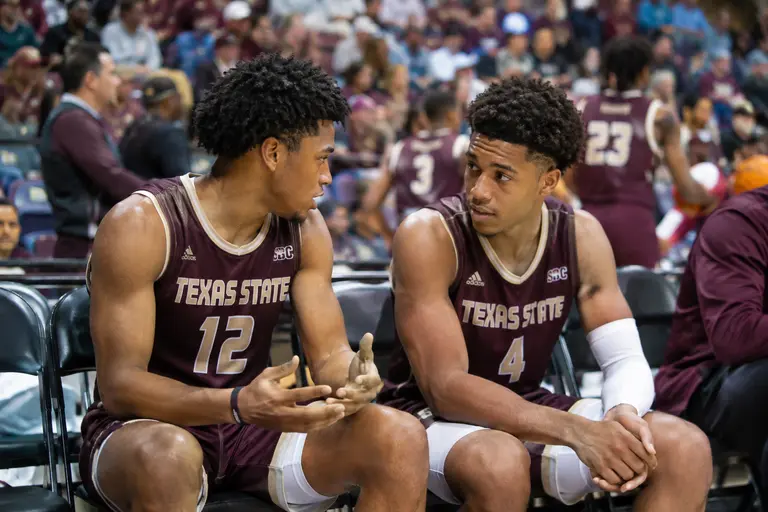
For Texas State Freshmen, Hall’s first year set a higher public standard. It showed that a new player could step in, earn touches, rebound at a strong rate and become one of the league’s recognized performers. That does not mean every recruit should be expected to match his immediate impact. In fact, Fields’ freshman season is just as useful for understanding how the roster works. Some players become statistical leaders quickly. Others create value by taking bench minutes, defending, rebounding and growing into bigger roles over time.
The 2026 class fits that same player-development idea. Sanders arrives with frontcourt size and a recruiting profile that will attract attention. Grandison brings a wing-sized guard frame from Overtime Elite. Livingston gives the class a point guard, though the public record does not yet offer a college stat line to judge. Each player gives Texas State a different question to answer through practice, early rotations and conference play.
That matters locally because San Marcos basketball supporters have more than one player arc to follow. Hall’s sophomore test is about whether award-level freshman production carries into a Pac-12 schedule. Fields’ next step is about whether bench experience turns into steadier frontcourt value. The new recruits bring the question of how quickly high school and academy production can translate to Texas State’s system. Those stories give the roster texture without needing to manufacture certainty.
Depth Has To Be Earned On The Floor
The freshman movement also speaks to competitive balance inside the team. Young talent can raise the ceiling, but minutes still have to be won. Hall earned a large role because his production demanded it. Fields earned court time off the bench across 30 appearances. The 2026 signees enter a roster where previous freshmen already created a benchmark for how quickly young players can become useful.
That internal pressure can help a program if roles are clear. A returning sophomore such as Hall gives the team a known producer. A second-year center such as Fields gives the staff size that has already been tested in college games. New freshmen then compete into a structure that has some proof behind it. For a team changing conferences, that kind of layered roster is healthier than depending only on transfers or only on upperclassmen.
Why Texas State Freshmen Matter In San Marcos
The freshman story is not just about recruiting rankings or award lists. It is about how Texas State is trying to carry young players into a larger basketball moment for the school. Hall’s 2025–26 season gave the Bobcats an immediate proof point. Fields gave the frontcourt bench real freshman minutes. Sanders, Grandison and Livingston give the next class a wider positional base.
Texas State Freshmen have already shaped the roster conversation because they connect the past season to the 2026–27 transition. Hall’s award year showed what early opportunity can become. Fields’ role showed why bench development has value. The 2026 commits show that the program is still adding young pieces rather than treating freshman talent as a one-year surprise.
For San Marcos, that is the part worth tracking as the season unfolds after November 7, 2026. The Bobcats’ youth is not separate from the team’s identity. It is one of the clearest ways to understand where the roster has been strengthened, where patience is still needed and why the next wave of player profiles will matter to the local basketball community.