
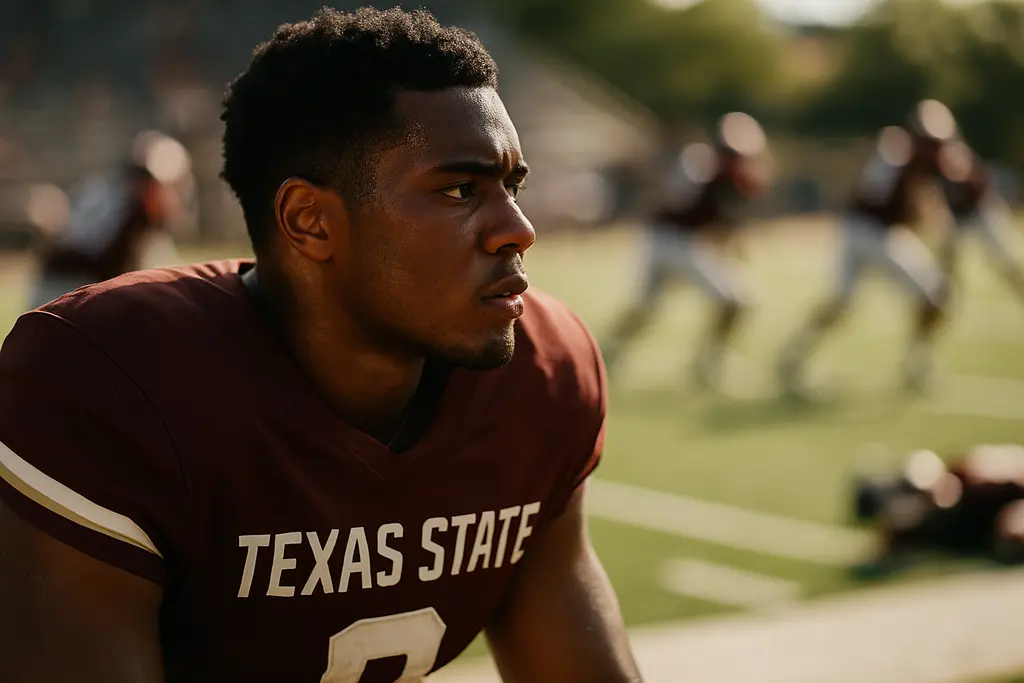

Texas State recruiting in the 2026 class has a clear local identity: the Bobcats built much of their high school group through Texas players, then paired that home-state base with select transfer additions. As of October 19, 2026, the class is best understood less as a star-count race and more as a roster-building move rooted in Texas high school football, San Marcos familiarity and position balance.
Texas State recruiting Starts With Texas Roots
Texas State recruiting By The Numbers
Third and Data lists Texas State’s 2026 high school recruiting group at 16 players, with a national class ranking of No. 74, 188.3 recruiting points and an average rating of 85.28 Texas State recruiting data. That same evaluation does not list any blue-chip high school signees for the Bobcats, which matters because it frames the class correctly: Texas State did not win 2026 by stacking four- and five-star labels in one place. The Bobcats won their local story by identifying players from within the state, filling multiple position groups and keeping a strong portion of their class tied to Texas football communities.
For Texas State recruiting, that approach fits the moment. The program is not trying to copy the roster model of the state’s largest brands. It has to find players who can grow inside the system, compete early where needed and give the staff enough developmental options across several spots. A 16-player high school group gives the staff room to build over time, while the broader commit board shows how the Bobcats blended prep additions with transfer help.
The In-State Share On The Commit Board
On3’s Texas State 2026 commit board lists 22 total commitments including transfers, and the group includes a heavy in-state high school presence, with roughly two-thirds tied to Texas prep football 2026 Texas State commits. That is the key local thread. The Bobcats did not simply add players from one pocket of the state. Their in-state names reach East Texas, North Texas, Central Texas and San Marcos itself.
That matters for families and fans around UFCU Stadium. Recruiting is often discussed through national rankings, but at Texas State the more useful question is whether the staff is strengthening ties to nearby high school coaches, keeping local players interested and giving Texas athletes a clear path to college football in San Marcos. The 2026 board shows a program still grounded in that home-state network.
Skill Talent Gives The Class A Local Pulse
La’Keyleon Graves Sets The Profile
La’Keyleon Graves is the most recognizable name in the class from a profile standpoint. The Kilgore athlete is listed by On3 at 6-foot-2 and 185 pounds, with a September 12, 2025 commitment date and a position tag that reflects his wide receiver and athlete versatility. His listed offers in the research included programs such as Houston, Missouri, Tulane, Wake Forest, Washington State, Tulsa, UTSA, Rice and North Texas.
The value for Texas State recruiting is not only that Graves came from East Texas. It is that his profile gives the Bobcats a player who can be viewed through several offensive possibilities. A bigger receiver body can help on the perimeter, in contested-catch situations and in packages where the staff wants size without sacrificing movement skills. If a player can also carry an athlete label, he may give coaches special teams and formation flexibility during his development arc.
There should still be care in how his immediate impact is framed. A high school commitment profile does not guarantee a fixed college role, and the Bobcats’ receiver room has to be sorted through practice performance, route detail, timing with quarterbacks and special teams reliability. But as a recruiting win, Graves gives the class a clear headline name from within Texas.
Wide Receiver Depth Reaches Beyond One Name
Blake McLane of Frisco and Dameon Crowe of Richardson add more in-state receiver presence. McLane is listed at 6-foot-3 and 190 pounds in the research, giving the class another larger target. Crowe gives the board another North Texas connection, which matters because the Dallas-Fort Worth area remains one of the state’s deepest recruiting zones.
Texas State has to keep finding receivers who fit both the speed of college football and the spacing demands of modern offenses. Size alone is not enough. Players have to separate, block, adjust to college coverage and handle the physical jump from high school to FBS football. Still, having multiple Texas receivers in one class gives the staff choices. Some may push early on special teams. Others may need time in the weight room. The key is that the room has more competition and more local flavor.
Line And Front-Seven Additions Balance The Board
Offensive Tackles And Tight End Size
The class is not built only around skill players. Teagan Lindsey of Callisburg and Eric Perkins of Marshall are listed as offensive tackles, while Russell Crawford of Marshall is listed as a tight end. That mix gives the Bobcats developmental size at positions where programs rarely feel finished.
Offensive tackle recruiting is often less immediate than receiver recruiting from a fan perspective, but it can shape a roster just as much. Tackles may need time to add strength, adjust their footwork and learn protections against faster college edge rushers. For Texas State, adding two tackles from in-state high schools gives the staff more long-term options at a premium position. Crawford’s presence at tight end also adds another body to a position that can bridge the run game and passing game, depending on how his frame and blocking work develop.
Defense Keeps San Marcos In The Picture
Darius Davis of San Marcos is one of the most community-connected names in the group because he comes from the same city as the university. His listing at linebacker gives local fans an easy player to follow, and it gives the program a direct link between the high school scene and the Bobcats’ roster.
Braylon Young of Denton is listed on the defensive line, adding another North Texas piece to the front. Defensive line development can take time, particularly for players adjusting to college strength and tempo, but the need for rotating bodies up front never goes away. If the Bobcats can turn Texas high school defensive linemen into dependable contributors, it helps the entire defense by reducing snap strain and creating more competition in practice.
- Juntavious Harris of Euless adds a Texas running back to the offensive group.
- Darius Davis gives the class a San Marcos linebacker connection.
- Braylon Young brings another in-state defensive line option from Denton.
- Teagan Lindsey and Eric Perkins give the staff two offensive tackle additions.
How The Class Fits The 2026 Roster Build
Development Is The Central Test
The class should be judged through fit as much as ranking. Texas State’s 2026 group does not rate as a blue-chip-heavy haul in the Third and Data evaluation, so player growth becomes the central measure. That means strength gains, practice consistency, special teams readiness and the ability to handle the mental jump from high school football to college game plans.
That is where the Bobcats’ in-state approach can help. Players from Texas are often familiar with high-tempo offenses, crowded playoff environments and deep position competition before they reach college. That does not make the transition easy, but it can shorten parts of the adjustment. It also helps the staff maintain relationships with high school coaches who know how players practice, how they respond to coaching and how their bodies may develop after graduation.
Roster Balance Matters More Than One Position
The 2026 in-state group touches nearly every phase of the roster: wide receiver, running back, offensive tackle, defensive line, linebacker and tight end. That balance is one reason the class carries more weight than a simple national ranking may show. If even a few players grow into rotation roles, the class can support the roster over multiple seasons.
For readers tracking the broader roster plan, the class also connects with Texas State’s transfer usage and position needs. Our earlier breakdown of Texas State’s 2026 roster keys fits with this class because high school development and portal additions are now part of the same roster conversation in San Marcos.
Why The 2026 Texas Class Matters In San Marcos
Local Recruiting Builds More Than Depth
Texas State recruiting has to serve the scoreboard, but it also serves the community. When players arrive from Kilgore, Frisco, Euless, San Marcos, Richardson, Callisburg, Denton and Marshall, the class gives families across Texas a reason to track the Bobcats more closely. That connection can show up in game-day travel, local attention and long-term trust between the university and high school programs.
The 2026 class is not a finished product, and it should not be treated as one. It is a starting point. The Bobcats have in-state skill talent, developmental line pieces and defensive additions who now have to earn roles through college work. The ranking tells one part of the story. The stronger local angle is that Texas State kept building through Texas high school football, with enough position variety to shape the roster beyond one signing cycle.
For San Marcos, that is the takeaway. The Bobcats’ future is not built only through national attention or transfer movement. It is also built through players whose high school roots are close enough for family, coaches and hometown fans to follow every step.